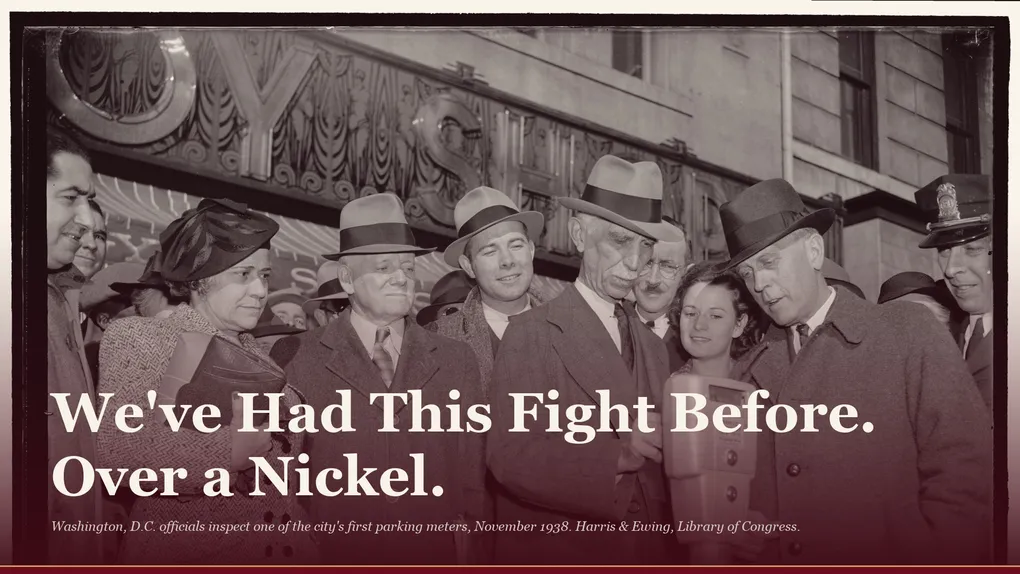
We've Had the Flock Camera Fight Before. Over a Nickel.
Those little cameras are on poles everywhere you look these days. They’re about the size of a shoebox, with a solar panel on top, and they photograph the license plate of every car that rolls past. Made by a company called Flock Safety, which is a great name if you want people to picture sheep instead of surveillance.
Nobody voted on these. They just showed up one day, and now a few thousand towns have them. Some folks love them. Some folks are showing up at city council meetings with the kind of energy usually reserved for zoning fights. And the arguments are always the same:
This is a public street. Who said you could do that here?
and
This is a public street. You shouldn’t expect privacy here.
Here’s the thing. We’ve had a similar fight before. Over a nickel.
He Shot a Judge, Then Invented the Parking Meter
Carl Magee was not a traffic engineer. He was a newspaperman, and a dangerous one to have around if you were on the wrong side of the law.
In the early 1920s he ran a paper in Albuquerque and started asking why the Secretary of the Interior, a New Mexico senator named Albert Fall, had suddenly come into a great deal of money. The answer turned out to be bribes from oil barons in exchange for no-bid leases on federal oil reserves. You know it as the Teapot Dome scandal. Fall became the first cabinet secretary in American history to go to prison, and Magee’s relentless reporting helped put him there.
That kind of investigative journalism makes enemies. One of them was a judge named David Leahy, who was tangled up in Fall’s political machine and had already convicted Magee of criminal libel. (The governor pardoned him.) In 1925, Leahy jumped Magee from behind in a hotel lobby in Las Vegas, New Mexico. Magee, who had taken to carrying a pistol for exactly this reason, pulled it and fired three times. One bullet hit the judge in the arm. Another killed a bystander who had rushed in to break up the fight. Magee was charged with murder, later reduced to manslaughter, and a jury acquitted him.
Then he moved to Oklahoma City and got into the parking business.
Oklahoma City Had a Car Problem
In the early 1930s, Oklahoma City exploded. Oil had been struck, and the population ballooned with car registrations going from about 3,000 to somewhere around a half million.
You know the drill. Too many commuters, too few places to park. People drove to work in the morning, parked in front of downtown businesses (stores and the like) and left their cars until five.
That was great for commuters and lousy for business. Shoppers grew frustrated at lack of parking and just went home. Merchants were not happy.
By this time, Magee was editing the Oklahoma News and served as chairman of the Chamber of Commerce traffic committee. His proposed fix seemed simple: put timers on parking spaces and charge by the minute. The idea was to… make you leave.
He filed a patent for this perceived abomination in December 1932 and sponsored a design contest with the engineering department at Oklahoma A&M (now Oklahoma State). The winning entry was submitted by Professor H. G. Thuesen and a young engineer named Gerald Hale. Nicknamed the “Black Maria,” the device was to be manufactured by an Oklahoma company that built timing devices for oil wells.
The Death of Free Parking
One Tuesday morning, 175 Park-O-Meters went live across fourteen downtown blocks. The original parking rate was five cents an hour, but overstaying your welcome would result in a ticket for $20. In today’s dollars, that ticket translates to just under $500. Ouch.
You can guess the public reaction. Exactly, it wasn’t exactly, “What a great way to free up more parking for retail customers!”
Complaints were off the charts, with letters to the editor (remember, no social media to gripe at) complaining of “un-American” abuse of power and illegal taxation. Those more constitutionally-minded considered it a deprivation of due process. You can probably relate. The people’s taxes paid for the street in the first place, so what’s with this vile new revenue program?
You can’t make up great stories from the past. Guess who got the first parking ticket under the new program? A preacher. Reverend C. H. North parked at a meter, realized he didn’t have a nickel, and ran into a store to get change. When he got back to his car, he found he’d already been ticketed. Yup. Just like today. They’re hiding out and watching for you to leave. He fought it in court and the parking meters remained.
Next, The Lawsuits
The legal challenges came fast, and not just in Oklahoma. We had an abundance of lawyers back then, too. Cities all over the country were salivating over Oklahoma City’s new revenue experiment and ordering meters of their own. And the lawsuits mounted.
Most of the lawsuits failed. Most of the time, courts ruled that meters were a legitimate way to regulate traffic, so long as the city could argue with a straight face that the money mostly covered the cost of the meters themselves. The presentation is always the important part. It was all about “traffic control,” not “revenue.”
In January 1937, the Alabama Supreme Court struck down Birmingham’s meter ordinance entirely. The court’s reasoning read like an angry OPED from the public. Streets were held in trust for the public, and property owners had a right to come and go and park in front of their own buildings without paying for the privilege. The meters’ “sole and only purpose,” the justices wrote, was “to exact a fee… to raise revenue for the use of the City.” In other words, the court saw it for what it likely was, a tax.
The “power to the people” ruling didn’t last. Alabama eventually came around, as did the rest of the country.
The Gotcha: The Program Worked
Here’s the twist. The people hated the meters. The downtown businesses loved them.
Merchants discovered almost immediately that the meters worked exactly as advertised. The all-day parkers vanished. Curb spaces turned over every hour. Retail traffic went up, sales went up, and downtown property values along the metered blocks climbed. The thing everyone was screaming about turned out to be the best thing that had happened to Main Street retail in a decade. In a strange way, some type of “greater good” prevailed.
By the early 1940s, about six years into parking meter armageddon, more than 140,000 parking meters were operating across the United States. A trade magazine called them the greatest traffic invention since the stoplight. Magee’s Dual Parking Meter Company and its successor, Magee-Hale Park-O-Meter, couldn’t build them fast enough.
After quite the diverse life, Carl Magee died in 1946. He’d exposed a cabinet secretary, survived a gunfight with a judge, and changed our streets forever. I have to wonder whether his descendants get hate mail.
Ninety-One Years Later
So, the interesting thing about today’s Flock camera debate…
The parking meter and the license plate cameras are running into the same question. What can happen on public streets? The ones we theoretically own?