Two Kentucky Prospectors Salted a Field With Diamonds and Conned San Francisco's Richest Men
In the spring of 1872, two cousins from Hardin County, Kentucky, walked into the Bank of California carrying a little leather sack. Inside were uncut diamonds, sapphires, and rubies. They didn’t want to sell them. They just wanted the bank to hold the sack in the vault. And when the clerks asked where the gems came from, the cousins got cagey. They mumbled something about “Indian country” and changed the subject.
Meet Philip Arnold and John Slack
Philip Arnold and John Slack were second cousins, both career prospectors, both good at it, and both completely broke after two decades of chasing gold and silver. The “broke” part arose from efforts that never quite paid off. By 1870 they were in San Francisco, and Arnold had a day job at the Diamond Drill Company, where he handled little industrial-grade diamond bits all day long.
Then, Arnold noticed something. San Francisco in 1870 had a wealthy economy and no reliable way to check whether a raw, uncut gemstone was worth a fortune or a nickel. Sounds like opportunity, doesn’t it?
The richest man in California takes the bait
Here’s the elegant part. Instead of an “active” con, the duo never approached anyone. They put the sack in the vault, acted twitchy, and let the bankers con themselves. Gossip about the two guys and a bag of gems spread like wildfire until it reached William Ralston, founder of the Bank of California and one of the most powerful money men on the West Coast.
Ralston had spent his whole career waiting for the next Comstock Lode, the silver strike that produced fortunes. Real American diamonds would top even that. He didn’t need any convincing.
So Ralston built a syndicate of the rich and famous: Civil War General George McClellan. Newspaper legend Horace Greeley. Future senators and a former Speaker of the House. And, best of all, Charles Tiffany. Yup, that Tiffany. These were the sharpest, wealthiest, most sophisticated men in the country, and every one of them was confident that he could not be fooled. Sounds a bit like those side interviews on Survivor where the contestant says, “I’m safe in tonight’s vote. I have these people under my complete control.”
Investing in the con
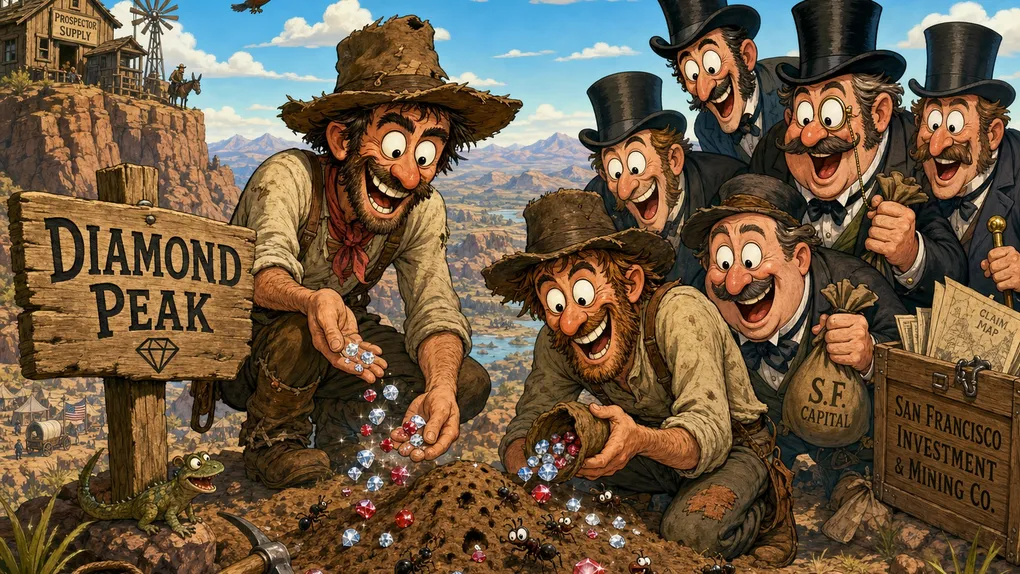
While the big cheeses lined up, Arnold and Slack went shopping. Two trips to Europe, London and Amsterdam, where they spent around $25,000 on junk gemstones including low-quality rough diamonds and garnets and sapphires that no jeweler would ever set in a ring. Then they hauled the whole pile to a remote mesa in the far northwest corner of Colorado, a spot chosen specifically because getting there was a miserable ordeal, and they scattered the gems by hand. Across the dirt. Into anthills. Lots and lots of glittering surprises waiting to be dug up by exactly the right suckers.
Prospectors have a word for this. They call it “salting.” Arnold and Slack salted an entire mountainside.
The Tiffany test: fail
Before anybody paid anybody, the syndicate did the responsible thing. They took a sample bag of the gems to Charles Tiffany himself, the most trusted jeweler in America, and asked him to appraise it. In a New York conference room, Tiffany studied the stones, nodded gravely, and valued the bag at roughly $150,000.
The real number was under $20,000.
How does a gemstone pro like Tiffany get it that wrong? Because Tiffany & Co. dealt in finished, cut, polished stones. Raw industrial rough was outside his lane, and nobody in that room knew enough about the topic to notice.
Four days in the dirt
Now the syndicate wanted to see the field with their own eyes, so they sent a mining engineer named Henry Janin, a man with a hard-earned reputation for smelling fraud. Arnold and Slack took him out by train, then wagon, then horseback, and blindfolded him for the last stretch. For secrecy, you understand.
For four days Janin dug and panned and sifted. He pulled diamonds out of anthills. He found rubies wedged in cracks. He picked gems out of the gravel under his boots. And the professional skeptic, the guy hired specifically to be suspicious, declared the deposit “wonderfully rich” and figured every single acre would cough up at least $5 million.
The syndicate paid Arnold and Slack $660,000 in cash, about $17 million today, then raised even more cash from outside investors and printed stock. Arnold went home to Kentucky. Slack vanished into the Southwest. The whole thing would have worked, except…
The geologist who figured it out
Clarence King was 30 years old and running the federal survey that had spent five years mapping this exact stretch of the West. In October 1872, he happened to share a train car with, of all people, Henry Janin, the mining engineer, who couldn’t help bragging about the gemstone field.
King’s ears perked up, and one geological fact started nagging at him. Diamonds and rubies don’t form together. So King grabbed his team and rode three days through deep snow to the mesa, and what he found settled it fast. Gems sitting right on top of the soil instead of buried in rock. Stones tucked into places nature would never put them. And the kicker, several diamonds with flat, tool-cut facets. Oops. Somebody had already been to the jeweler.
King’s expedition exposed the con.
Time to pay the piper
The syndicate refunded its outside investors from its own pockets, but the damage was done. The Bank of California wobbled and eventually collapsed, and in 1875 William Ralston walked into San Francisco Bay and drowned, at 49. Nobody’s sure whether it was a swim or an intentional goodbye.
As for the two cousins, Philip Arnold went home rich, opened his own bank, got into a shootout with a rival banker, caught pneumonia while recovering from the buckshot, and died in 1878. Also 49. John Slack made it the longest and used it the least. He drifted to New Mexico, became a coffin maker, and died in 1896 without ever telling a soul his story.
And Clarence King, the hero? He became the founding director of the U.S. Geological Survey, a celebrity scientist, then blew the rest of his life on his own doomed mining schemes and died broke in 1901, living under a fake name.
That mesa is still out there, near a spot called Diamond Peak. And every so often, some geologist wanders across a low-grade diamond lying in the dirt, a little leftover glitter from the con that fooled everybody who was too smart to be fooled.