The Morning the Northern Lights Powered the Telegraph
In 1859, a solar storm caused such a disturbance here on Earth that telegraph operators in Boston and Portland unplugged their batteries and... everything kept running for a solid two hours based on nothing more than "power from the sky." It almost happened again in 2012.
Even old-school communications like the telegraph required electricity. But back on September 2, 1859, the laws of physics seemed to take a day off as a Boston telegraph operator named Milliken disconnected his batteries and kept right on sending dots and dashes to Portland, Maine.
As it turns out, this “new” and temporary power supply was the northern lights.
Yes, really.
A flash, and nobody around to see it
A wealthy Englishman named Richard Carrington had his own observatory outside London. On the morning of September 1, he was projecting the sun’s image onto a screen (remember, don’t stare at the sun!) and was mapping the dark spots. Just before noon, a big cluster of spots broke out in what he described as “two patches of intensely bright and white light.”
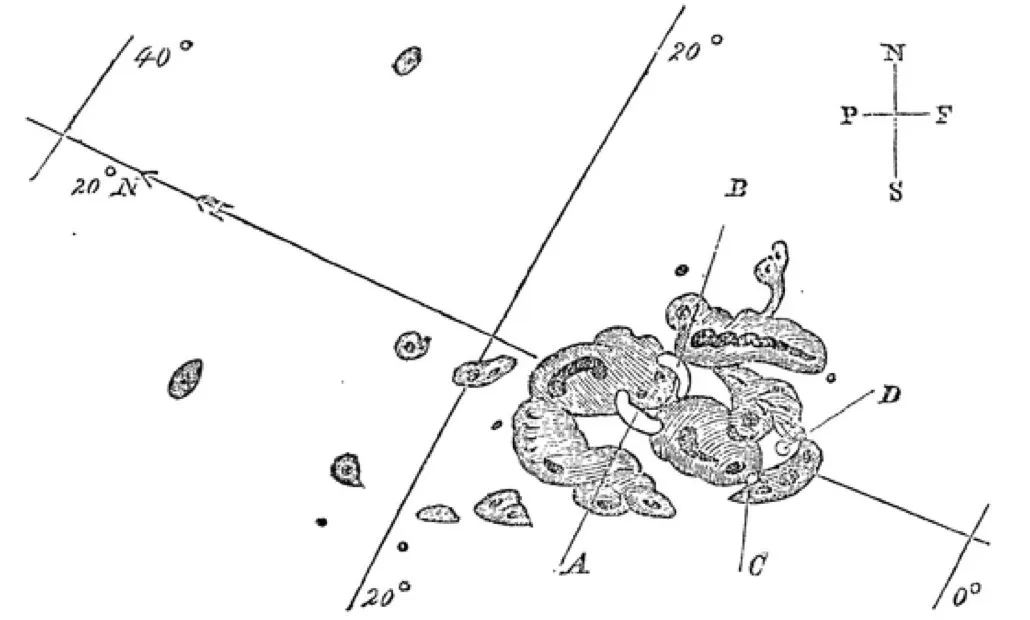 Carrington’s own sketch of the sunspot group. A and B mark where the flare broke out; C and D, where it faded. (Monthly Notices of the Royal Astronomical Society, 1859)
Nobody had ever recorded anything like it, so he ran off to find a witness. As he later wrote, he, “on returning within 60 seconds, was mortified to find that it was already much changed and enfeebled.”
As it turned out, he’d witnessed part of the first solar flare ever recorded. Luckily for his reputation, another English astronomer, Richard Hodgson, saw the same flash on his own, so Carrington’s seemingly fantastic story was backed up by another reputable observer.
What neither saw was the giant cloud of magnetized gas the sun had launched toward Earth. The cosmic cloud made the sun-to-Earth trip of 93 million miles in about 17 and a half hours, a journey that normally takes several days.
Plugging in the sky
That night, auroras showed up in unusual places, from Cuba and Hawaii to Colombia, not far from the equator. The “northern” part of the northern lights is there for a reason.
In Boston, the effects were “so brilliant that at about one o’clock ordinary print could be read by the light,” the New York Times reported. A party camped high in the Rockies woke up a little after midnight, and some of them “insisted that it was daylight and began the preparation of breakfast.”
Even the wildlife was fooled by the phenomenon. The New Orleans Daily Picayune reported a man shot three larks around 1 a.m. after they came out “supposing it was day.” Apparently, early birds don’t always catch the worm.
Closer to my home, the Charleston Mercury ran a Sullivan’s Island woman’s account. “The eastern sky appeared of a blood red color,” she wrote, and “the shells on the beach, reflecting light, resembled coals of fire.”
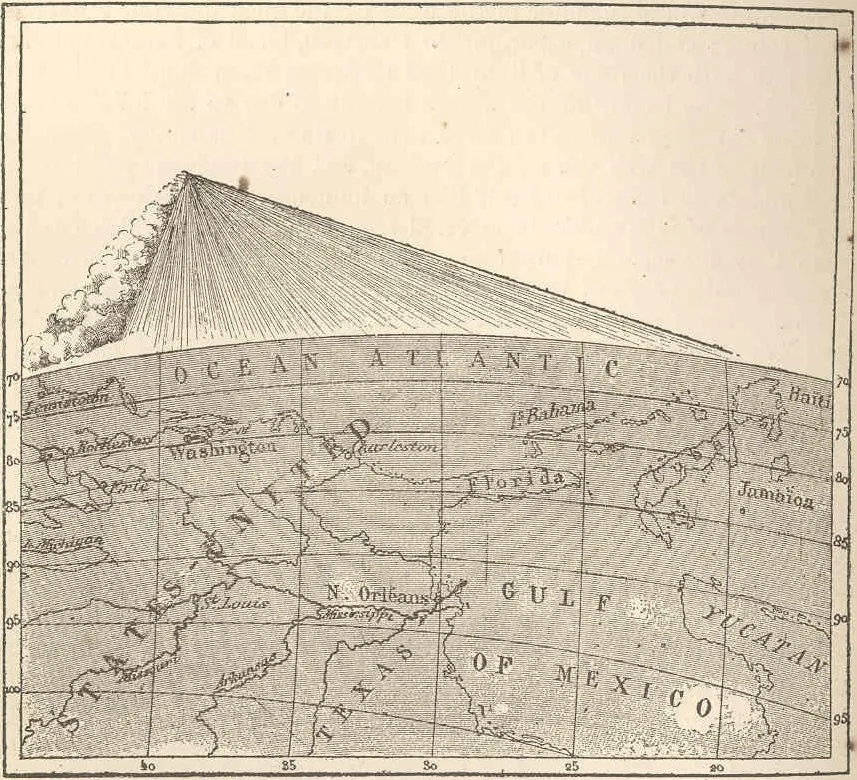 An 1873 textbook map of how far south the August 28, 1859, aurora reached. Look for Charleston, Cuba and Jamaica. (Élisée Reclus, Ocean, Atmosphere, and Life)
Shocking behavior
For the electrically driven telegraph industry, the whole affair wreaked havoc. An earlier solar storm had already hit on August 28, and the wires picked up strange electrical currents kicked up when the storm shook Earth’s magnetic field. In Washington, Frederick Royce grazed a ground wire with his forehead and got a substantial shock. A nearby man described “a spark of fire” jumping from Royce’s head to the equipment. Ouch.
Battery-less telegraphs
Back in Boston, when the American Telegraph Company office opened at 8 a.m. on September 2, the telegraph lines were useless. The aurora’s current came in waves, powerful enough to overload instruments and prevent battery operation. Around 8:30, somebody thought of a way to embrace the chaos and try going with the flow. They removed the batteries to see what the electrified sky would do.
So, the Boston office asked Portland to cut off its battery, too. When Boston asked how the messages were coming through, Portland answered, “Better than with our batteries on.”
Milliken continued to send private messages for more than two hours, powered by nothing but the aurora, until it faded. Then it was back to business as usual, running the telegraph system with actual batteries.
Old-time exaggeration?
Nope. The same thing nearly happened again on July 23, 2012. The sun cooked up another storm that Daniel Baker of the University of Colorado called “at least as strong as the 1859 Carrington event.” The only difference was that the 2012 event missed us. “If the eruption had occurred only one week earlier, Earth would have been in the line of fire,” he said.
Good thing. Back in 1859, wired technology was limited. While our ancestors had to worry about the telegraph system, we’ve got power grids, satellites, GPS, and plenty of computers. A 2013 Lloyd’s of London study estimated today’s cost of a Carrington-size event at $600 billion to $2.6 trillion in the United States alone.
On the plus side, we’re much better able to watch for such events now. NOAA’s Space Weather Prediction Center keeps an eye on the sun and sends warnings so power grid and satellite operators can protect their gear. When a big storm in May 2024 created “northern” lights as far south as Puerto Rico, most people just grabbed their phones and took pictures.
Mr. Milliken got two free hours of electricity out of it. I’d be happy for a blender that makes margaritas on northern lights.