The First Air Traffic Controller Brought His Office in a Wheelbarrow
The next time you’re stuck on a runway, seat belt buckled, listening to the captain announce that we’re “number 38 for departure” (I’m looking at you Atlanta Hartsfield) consider for a moment the folks working in the tower. They’re juggling radar screens, radio chatter and a few hundred tons of 500 mph aluminum tubes, all so you can get to Cleveland all safe and sound.
Now, ponder how the very first guy to control airplanes did the job.
Here’s a hint. It was back in 1929, and he went to the office with a wheelbarrow.
The Barnstormer Regains His Sanity
Archie League was born in Poplar Bluff, Missouri, in 1907, back when airplanes were mostly a way to thrill county-fair crowds. You know, a 50/50 chance to see some daredevil splatter himself all over the countryside. By his teens he had pilot’s and mechanic’s licenses. Through the 1920s he flew with a barnstorming flying circus around Missouri and Illinois, doing loops, spins and dives for people who’d paid good money to watch a young man maybe not die.
Then a fit of self-preservation instinct kicked in, and he shifted from the “hope I make it home for dinner tonight” business to the “let’s see if we can make flying safer for everyone” business.
St. Louis aviation had a problem. Its airfield was getting busy (by 1929 standards, anyway), and planes coming and going needed somebody to help organize things. By this time, lots of towns had traffic lights for cars, so it wasn’t much of a leap to consider ways to control the flow of aircraft. On January 1, 1929, the city hired 21-year-old Archie League to handle the task. The FAA says he’s “usually regarded as the first air traffic controller.” Whatever was going on at other airfields, we’re pretty clear that Archie was among the first of what we now call air traffic controllers.
Archie’s “Tower”
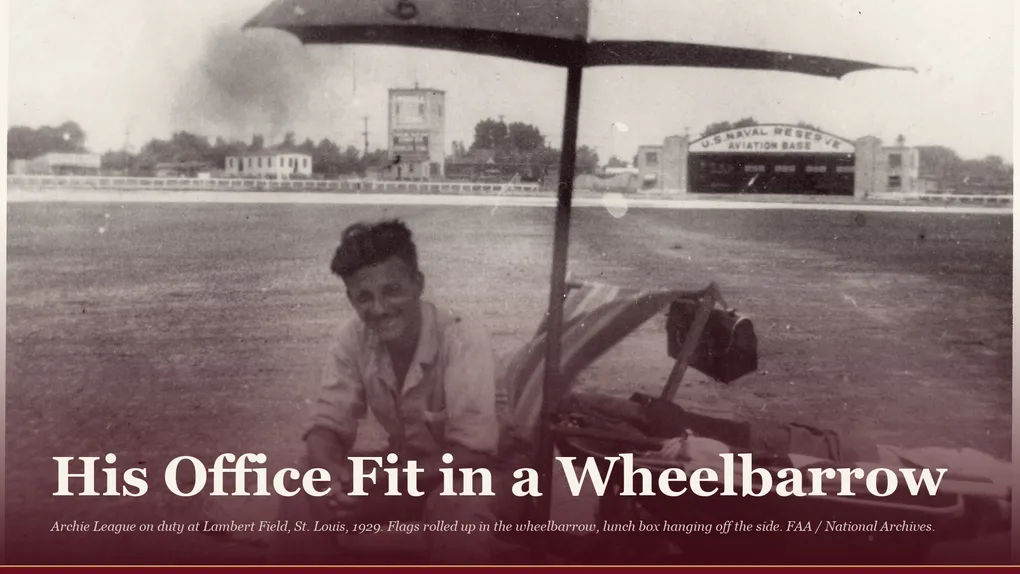
Every morning, Archie loaded up a wheelbarrow and pushed it out to the edge of the field. There were no towers, so he had to bring all the gear required: a folding chair, a beach umbrella, drinking water, a notepad, his lunch and two flags.
The flags were the air traffic control system. Checkered meant go. Red meant hold. That’s it. No headset, no radar, no “Delta four-two-niner, turn left heading two-seven-zero.” Just a young guy in a deck chair waving at pilots who, one hopes, were paying attention.
I suspect his days off caused some chaos.
The job wasn’t all shade and sandwiches, though. Pilots sometimes knocked over his umbrella. That kinda makes sense when you consider the prevalence of daredevil barnstorming at that time. You know it was a challenge to clip that umbrella with a wingtip or blow it over with propwash. While great in the spring, summer and fall, winters out on that open, windy field had to be chilling to the bone. There’s another photo in the archives showing League zipped into a padded flying suit and cap, checkered flag in hand, wheelbarrow waiting behind him. He looks freezing. And strangely cheerful.
The Mouthwash Airport
Great stories always have a diversion, and this one does too. The field where League worked was named for Albert Bond Lambert. The name likely does not sound familiar, but the Lambert family fortune came from Listerine.
Yes, the mouthwash. Lambert ran the family pharmaceutical company, and in 1920, the same year he leased 170 acres of farmland for an airfield, the company’s marketers started giving Americans a complex by talking about halitosis. Brilliant. Give a condition that destroys your self esteem a scary medical-sounding name and you’ve got the marketing success of the century. As a result, Listerine sales took off. So did Lambert’s airport. You could argue St. Louis aviation was built, at least in part, on the nation’s fear of bad breath.
Lambert was a real-deal aviation nut. He was the first licensed pilot in St. Louis. A young Charles Lindbergh showed up at his field in 1923 and stayed on as a flight instructor. Later, Lindbergh flew the airmail route between St. Louis and Chicago out of that same field as chief pilot. And when Lindbergh went chasing the prize for the first nonstop flight from New York to Paris, Lambert pledged the first $1,000 toward the effort. No one knows if the Spirit of St. Louis was stocked with a small bottle of Listerine to prep for meeting all those VIPs in Paris.
In 1928, St. Louis voters approved a bond issue, and the city bought the field from Lambert at his cost. A few months later, the new owners decided somebody ought to be directing traffic out there.
Enter Archie and his wheelbarrow full of supplies.
Up From the Dirt
The flag system didn’t last long, which was probably good for everyone’s blood pressure and aviation safety. By the early 1930s, League had moved up, literally, into a little glass booth on top of a hangar, with a radio. Not a bad promotion: flag guy to the airport’s first radio controller. Light guns replaced the flags.
League kept climbing the corporate ladder. He earned an aeronautical engineering degree from Washington University. In 1937 he joined the Bureau of Air Commerce, the federal agency that would eventually become the FAA. During World War II he flew for the Army Air Forces in the Pacific. After the war he went right back to keeping airplanes apart, and by the 1960s he was running air traffic services for the whole country.
When he retired in 1973, he was an assistant administrator of the FAA. Not bad for a guy whose first control tower had one wheel and two handles.
I guess that’s called working your way up the ladder from the dirt floor.
One More for the Road
Here’s a bonus you can use at your next dinner party. League was born on August 19. In 1939, Franklin Roosevelt made August 19 National Aviation Day, because that’s Orville Wright’s birthday. So the first air traffic controller shares a birthday with half of the team that started all this flying business in the first place.
Today, the air traffic controllers’ union hands out the Archie League Medal of Safety every year to controllers who talk pilots through their worst days. The winners work in dark rooms full of radar screens, headsets and computers that would have looked like witchcraft in 1929.
These days the flags are gone. Well, mostly. Control towers still keep a light gun handy, a spotlight that fires a beam of red, green or white. If a plane’s radio quits, the controller aims it at the cockpit to signal basic instructions. Steady green means cleared to land. Steady red means give way and keep circling. Flashing red means the airport’s unsafe, so don’t land. Student pilots still have to memorize the whole chart to pass their exams.
My favorite is flashing white, for planes on the ground. It means “return to starting point.” Maybe that’s the aviation version of a “time-out.”