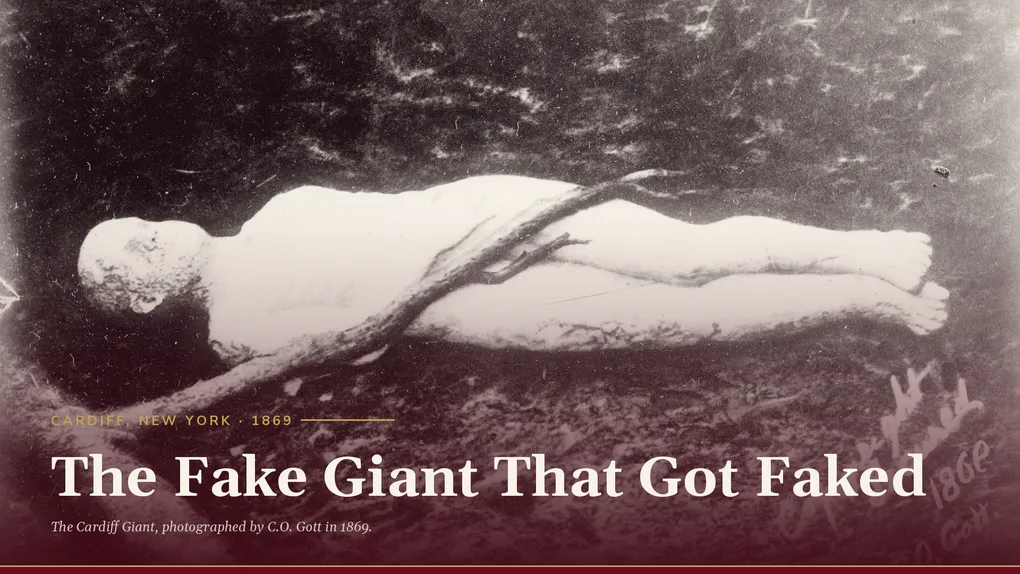
The Fake Giant That Got Faked
In 1869 a skeptic buried a fake stone giant in New York to prove how easily people can be fooled. Then P.T. Barnum faked the fake, and his copy drew the bigger crowds.
In October 1869, two men were hired to dig a well on a farm in Cardiff, New York. While digging, they hit stone, so they kept going, trying to figure out how to get around it. Turns out the stone obstruction was about 10 feet long. When they finally uncovered the obstacle, they were dumbfounded to see a giant stone man who had been buried behind the barn for who knows how long.
Enter opportunity for a quick buck. Within days, people were lining up to drop 50 cents for a look at the stone giant.
Sadly, this was not some weird fossilization of a prehistoric giant. It was a fake, as you might have guessed. Fake or not, there’s a fun story of how this all came about, and what happened later. Spoiler alert. This story has nothing to do with how the New York Giants football team got their name.
A Biblical Argument Spirals Out of Control
George Hull was a New York tobacconist and a dedicated skeptic. He found himself arguing with a Methodist preacher over Genesis 6:4. That’s the verse that says, “There were giants in the earth in those days.” The preacher argued for the literal interpretation, but Hull disagreed. Hull ended up losing the argument.
So Hull refused to give up and made his point another way. He figured if people would believe in giants because the Bible said so, how fast would they believe in giants with a little bit of physical evidence? A plot was hatched, and Hull invested more than $2,600 (a lot of money at that time) to make his point.
In 1868, he had a ten-foot block of gypsum quarried in Fort Dodge, Iowa, telling the quarry workers it was for a Lincoln monument. Workers in Chicago carved it in secret, reportedly hanging quilts to muffle the noise. Hull actually modeled for the statue himself, so it ended up wearing his face. To age the statue, workers scrubbed it with sand, beat it with steel knitting needles and treated it with sulfuric acid.
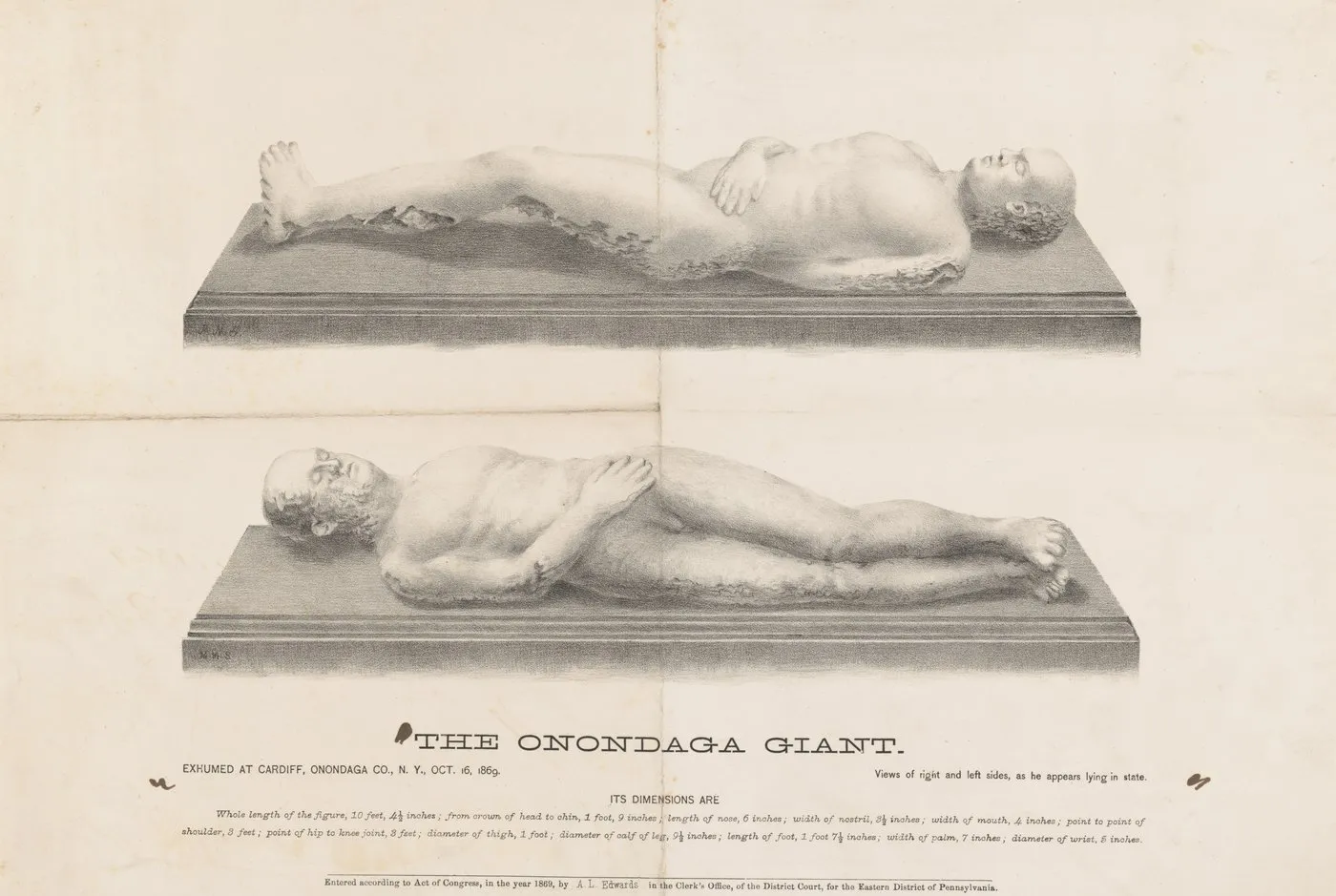 An 1869 souvenir print of the giant, “as he appears lying in state.”
That November, Hull had it sent to his cousin Stub Newell’s farm in Cardiff, NY. They buried it on the property and waited for almost a year.
A Fishy Well
Next step: Newell hires a couple of guys to dig a well in just the right spot, then acts shocked at what they find.
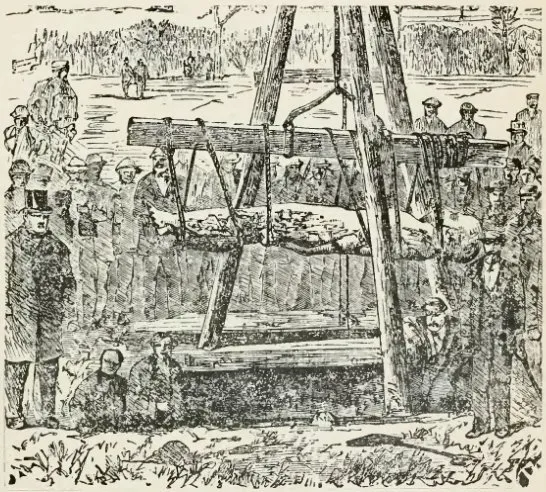 Hoisting the giant out of the ground, as drawn in a 1903 history of Iowa.
But there was a gotcha. The well was in an odd location because it wasn’t close to the house or barn. And there was an existing spring and a good stream already present. The first president of Cornell University came out for a look and pointed these things out immediately.
Then Yale paleontologist Othniel C. Marsh noticed something else. Gypsum dissolves in wet conditions. If this giant had been buried for centuries, he wouldn’t be looking so fresh. He pronounced his verdict: “a most decided humbug.”
It didn’t matter. A group of businessmen paid a small fortune for the stone giant and took him to Syracuse. Even more people lined up and paid for a look at the unnatural wonder.
P.T. Barnum Fakes the Fake
Enter the consummate showman. P.T. Barnum wanted to buy it from the present owners. History is a bit divided on the details of a purchase or rental offer, but no matter. They refused to sell to Barnum.
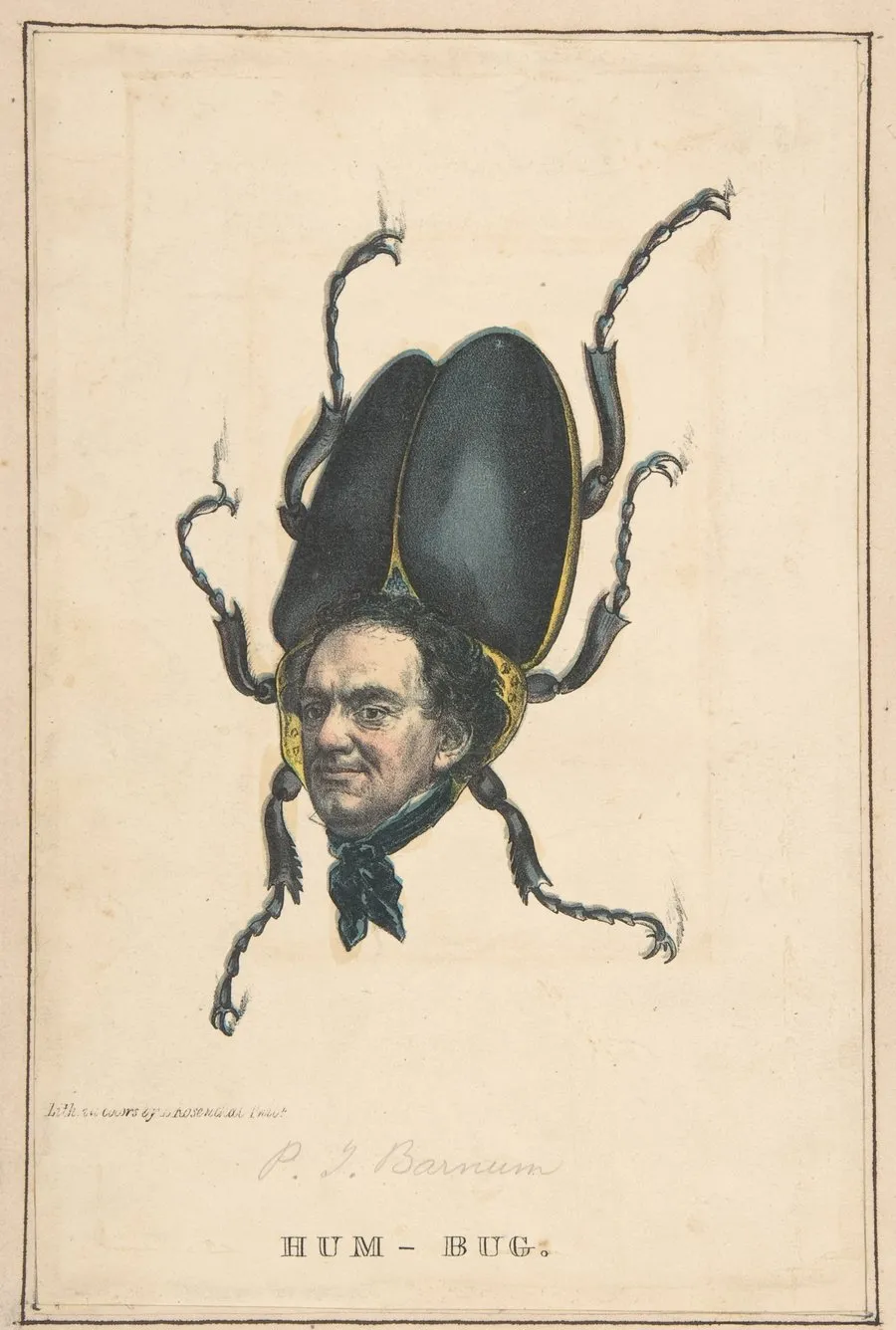 Barnum as a “Hum-Bug” in an 1851 caricature, 18 years before Marsh used the same word on the giant.
So Barnum built his own. He had a man model a wax version and built his own giant made of plaster. He put it on display in New York City and told everyone that his giant was the real one. It didn’t take long for Barnum’s version to overtake the “original.” Marketing matters.
So the gypsum giant’s owners took Barnum to court, but the judge wasn’t having any “fakes of fakes” nonsense. He said they could have their injunction if their giant would come in and swear he was genuine. Apparently the giant simply replied with a stony stare and refused to testify. That December, Hull finally confessed the whole story to the newspapers.
A Sucker Born Every Minute
You’ve heard it. “There’s a sucker born every minute.”
Everybody credits P.T. Barnum with the phrase, but his own biographer couldn’t find any concrete (sorry, I can’t stop with the stone references) evidence that he ever said it. Some stories attribute the saying to David Hannum, one of the original giant’s owners, grumbling about the folks lining up to see Barnum’s copy. Others trace it to unnamed gamblers and con artists.
Here’s the thing. People kept paying to see both fake giants after the confession became public, even calling the original “Old Hoaxey.”
The gypsum giant served as a coffee table in an Iowa publisher’s basement social room. Today he rests at the Farmers’ Museum in Cooperstown, New York, just down the road from the Baseball Hall of Fame. Barnum’s copy is supposedly still out in the wild also. A Michigan arcade owner claims he’s got it.
It’s a bit ironic that Hull intended to prove there were no giants on Earth. But in the end, he left us two of them.