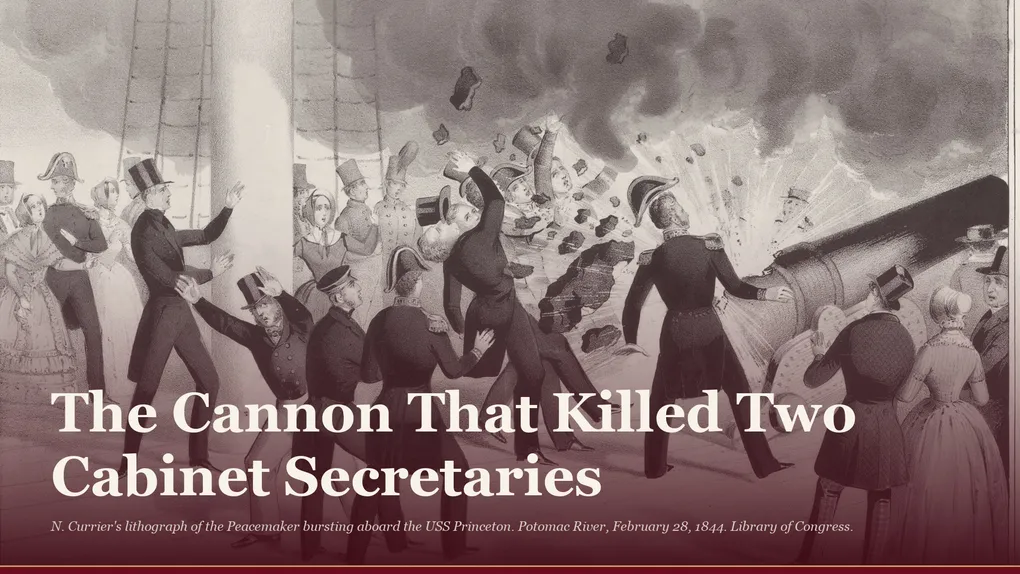
The Cannon That Killed Two Cabinet Secretaries and Made a First Lady
Somebody named the gun Peacemaker. Whether the name fits, I guess that depends on how one counts creating peace.
On the last day of February 1844, four hundred people boarded the USS Princeton at the Alexandria dock, dressed for a party, and steamed down the Potomac. As one might expect, there was a band, and Captain Robert Stockton greeted guests in full dress uniform. On board were the president, most of his Cabinet, half a dozen senators, Dolley Madison, and a twelve-inch cannon that weighed thirteen tons.
You might see where this is going.
A floating campaign ad
The Princeton was the most advanced warship on earth, and everybody attached to her wanted the credit, hence all the politicians present. She ran on a screw propeller instead of paddlewheels, engines were mounted below the waterline where enemy fire couldn’t reach them. Congress adjourned for a day so members could go tour her. John Quincy Adams, by then a cranky old congressman, grumbled that the Navy was showing her off to “fire their souls with patriotic ardor for a naval war.”
President John Tyler needed some good PR. He’d inherited the office when William Henry Harrison died after thirty-one days, vetoed enough bills that his own party expelled him, watched his entire Cabinet resign except for one man, and buried his wife in the White House. His nickname around Washington was “His Accidency.”
Two guns, and only one of them real
Here’s the thing about the Peacemaker, besides the fact it was in vogue to name cannons.
The ship’s other big gun, the Oregon, came from John Ericsson, the Swedish engineer who actually designed the Princeton. Ericsson built it by shrinking red-hot iron hoops around the breech, squeezing the metal into a permanent state of pre-loaded tension. That’s the whole trick. That’s why it held when its massive amounts of powder were set off. It was proof-fired more than 150 times before anybody considered it safe. Well, relatively safe.
Stockton wanted a second big gun, and he wanted this one to be his. So he had a copy built in New York, except he’d missed the point of the hoops entirely. Figuring thicker must mean stronger, he piled on metal until the thing weighed 27,000 pounds, more than half again as heavy as Ericsson’s and considerably more impressive to look at.
He test-fired it five times. Then he certified it and bolted it to a deck he was about to fill with a large portion of the United States government.
The song
The Peacemaker fired three times on the way downriver without any trouble, and the guests went below for lunch. Coming back upstream past Mount Vernon, Secretary of the Navy Thomas Gilmer talked everyone into climbing up for one more shot as a salute to Washington.
Tyler started up the ladder and stopped. His son-in-law had launched into a song, and the president stayed to hear it out.
Stockton pulled the lanyard and the left side of the gun tore open, throwing red-hot hunks of iron across the deck. Six men died: the Secretary of State, the Secretary of the Navy, the Navy’s chief of construction, a Maryland official, a New York lawyer named David Gardiner, and a young enslaved man named Armistead who worked as Tyler’s valet. Roughly twenty more were hurt.
Tyler came up to the deck, and, by one reporter’s account, wept.
Nobody had thought this part through either. Tyler had no vice president, because nobody had bothered to invent a way to replace one until 1967. Had he taken those steps twenty seconds sooner, the country would have woken up governed by the president pro tempore of the Senate, a North Carolinian named Willie Mangum, whom nobody outside North Carolina had voted for anything.
Four months later
David Gardiner had brought his daughters aboard. The younger one, Julia, was twenty-three, a New York socialite who had once mortified her family by secretly posing for a department store ad under the name “The Rose of Long Island.” Shocking, I know.
She had also turned down a marriage proposal from the president of the United States. Twice, more or less.
Julia was below deck when the gun burst. When she learned her father was among the dead, she fainted, and the man who carried her off the ship was Tyler. They married quietly in New York on June 26, four months after the tragic event. He was fifty-four. She was twenty-four. They had seven children, the last born when he was seventy, and two of their grandsons were still alive in 2020.
Abel Upshur, the Secretary of State killed standing next to the gun, had been days from delivering the treaty that annexed Texas. His replacement fumbled it, and Texas became the fight that dominated the 1844 election instead.
Who knows? If they’d named that cannon something more aggressive than Peacemaker, things might have been even worse.