The 62-Day Army Road Trip That Gave Us the Interstates
Back in the summer of 1919, a bored 28-year-old Army officer ended up on an epic road trip. His mission wasn’t exactly clear, as no one had given him clear orders on how to report on this event. By his own account of the story, he went “partly for a lark, and partly to learn.”
Thirty-seven years later, that lark of a trip turned into something quite useful: our national interstate system.
The young officer in this story was a name you’ll recognize: Lieutenant Colonel Dwight D. Eisenhower. The trip was an Army experiment to see if and how they could drive a full convoy across the country. The recently concluded First World War showed everyone the importance of mobile logistics, and the critical need to be able to move lots of weight long distances. In a hurry. Bottom line: the Army was charged with defending this country, but didn’t know if it could actually move the gear necessary to accomplish that task.
On July 7, 1919, 81 vehicles and just under 300 men departed Washington, D.C., headed west for San Francisco. Think in terms of a miniature army on wheels: cargo trucks, ambulances, mobile kitchens and even a blacksmith shop. Motorcycle scouts zipped ahead to post signs so the rest of the convoy wouldn’t get lost.
A quick side note. Eisenhower didn’t actually join the convoy until it arrived at its first overnight destination in Frederick, Maryland, about 50 miles into the cross-country trip.
The important thing to picture in your mind is that the “highways” on this road trip were nothing like today’s. For example, the convoy got on the Lincoln Highway at Gettysburg, and “highway” turned out to be a generous description. Maryland and Pennsylvania were fine. Ohio and Indiana were mostly paved. That’s right. “Mostly.” Then they reached Illinois, and from that point on, things were a bit sparse. In Eisenhower’s words, “practically no more pavement was encountered until reaching California.”
About half the trip was completed on dirt roads. Picture wheel ruts, desert sand, and mountain trails. Even bridges exposed new challenges. The covered ones near Gettysburg had roofs too low for the larger trucks. Wooden bridges in the more rustic west broke under the convoy’s weight. The engineers had to rebuild dozens of them as they went. And then there was the sand. In western Nebraska, that obstacle consumed two full days of the schedule. Eisenhower described the stretch from Orr’s Ranch, Utah, to Carson City, Nevada, as “one succession of dust, ruts, pits, and holes.”
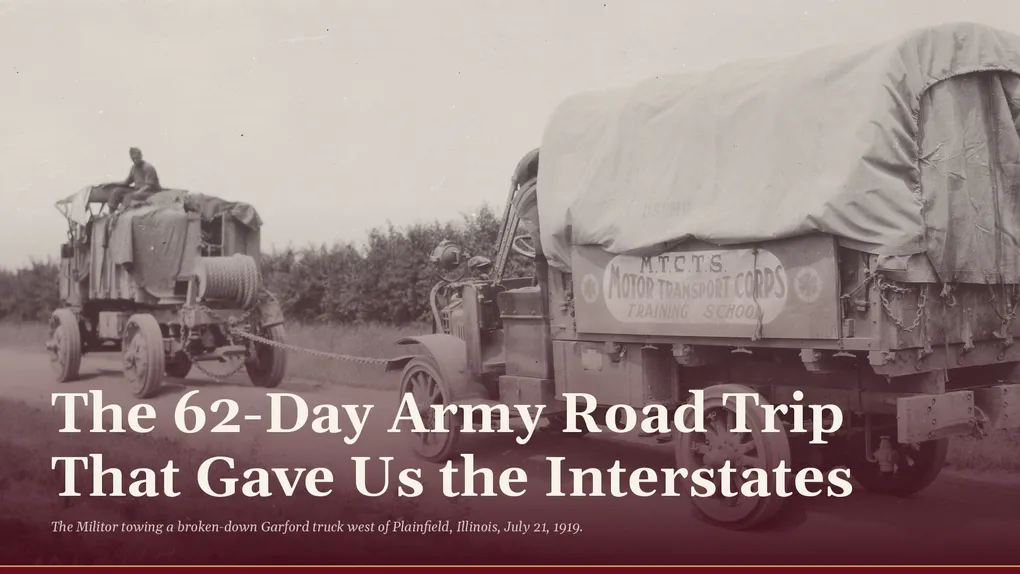
Fortunately, the convoy included a savior truck called the Militor. It was a monster, including four-wheel-drive and a hefty power winch. Good thing it was on the guest list, as it spent much of its trip dragging all the other Army vehicles out of hazards. Eisenhower said it “did wonderful work in pulling vehicles out of holes, sand pits, etc.” One night it arrived at camp towing four trucks. Another observer reported it once hauled nine at the same time.
The travelers had their work cut out, but at least the efforts were appreciated. During the journey, the convoy passed through around 350 communities. Many hosted parades, band concerts, picnics, street dances, and banquets celebrating the weary troops. Harvey Firestone fed them a fried chicken dinner at his farm in Ohio. An estimated 3 million people came out to watch a slow-motion traffic jam. The convoy averaged just six miles per hour.
The celebrations weren’t entirely spontaneous. Some forward thinkers were keen on “selling” the country on the importance of a good road system, and the Lincoln Highway team promoted the trip.
Eisenhower had a little fun along the way, too. By his own later telling, he and a buddy convinced the convoy that an Indian attack was coming when the convoy was in western Wyoming. Then they crept outside camp after dark and let out Indian war whoops. A jumpy young sentry fired his gun, and somebody nearly sent a telegram to the War Department reporting hostile Indians.
At long last, the convoy reached San Francisco on September 6. If you’re keeping count, that’s 62 days and about 3,250 miles later. Nine vehicles perished along the way. Twenty-one men were hurt and left behind.
That fall, Eisenhower wrote his report about the trip. His verdict went straight to the point. Long truck trips through the middle of the country were impractical “until roads are improved.”
Years later, World War II highlighted the value of Germany’s autobahn system. Later, in his memoir, Eisenhower put it this way: “The old convoy had started me thinking about good, two-lane highways, but Germany had made me see the wisdom of broader ribbons across the land.”
In 1956, President Eisenhower signed the law that built the Interstates.
Sometimes a lark plants a seed or two for greater things down the road.