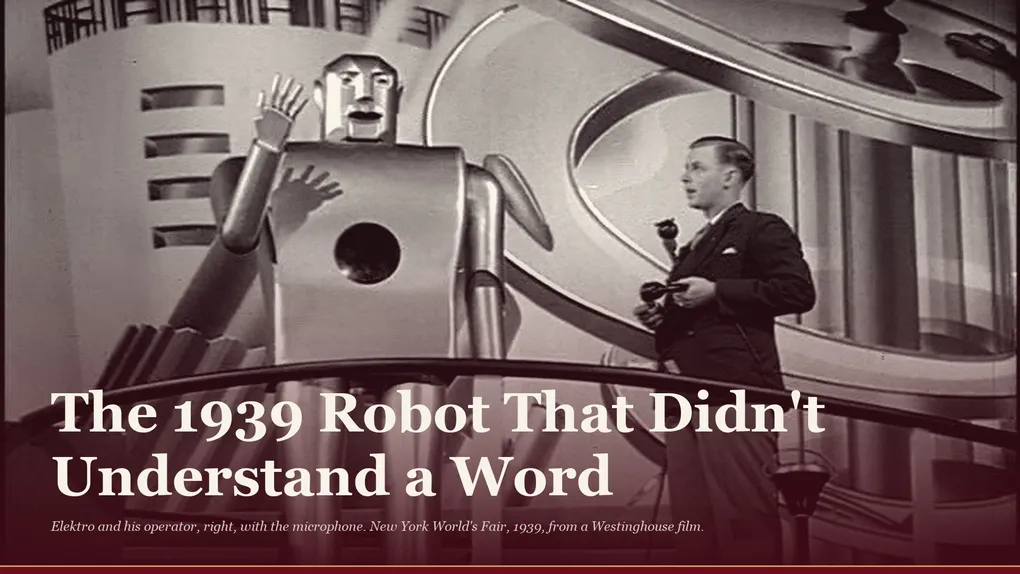
The 1939 Robot That Didn't Understand a Word
In the spring of 1939, if you wanted to see the “real” future, you stood in line in Queens, hoping for a glimpse at the impossible.
The place was the Westinghouse pavilion at the New York World’s Fair. People waited. And waited. What they were waiting for stood seven feet tall, weighed about 260 pounds, and was built from aluminum sheeting stretched over a skeleton of gears, cams, and motors.
His name was Elektro. He came out, faced the audience, and opened with this:
“Ladies and gentlemen, I’ll be very glad to tell my story. I am a smart fellow as I have a very fine brain of 48 electrical relays.”
Later in the act, he’d get cocky. “My brain is bigger than yours,” he’d tell somebody in the front row. At fifty-five pounds, it was.
A quick diversion. Your smartphone has somewhere in the neighborhood of 20 billion (with a “B”) “relay” equivalents. Back to the story.
He Counted On His Fingers and Smoked Cigarettes
Elektro had twenty-six tricks in him. He walked. He talked, with a vocabulary of roughly seven hundred words. He counted on his fingers. He sang. I’d really like to hear that now. A couple of years in, Westinghouse added a second hole in his upper lip, hooked him to an air compressor, and let him challenge audience members to balloon-blowing contests. He almost always won. Because he was a machine.
And he smoked like Bette Davis, albeit with somewhat less style.
An assistant would walk over, place a lit cigarette in a hole in Elektro’s upper lip, and step back. Elektro drew on it and blew the smoke out in short, satisfied puffs while ten thousand people lost their minds. Because in 1939, apparently nothing said World of Tomorrow like a machine with a nicotine habit.
After every performance, somebody had to clean the tar out of his tubing. Apparently, smoking kills robots too.
Nobody Was Actually Talking To Him
An operator stood on stage beside Elektro, holding what looked like a telephone handset, and spoke commands into it. Elektro obeyed. The whole thing read as a conversation between a man and a machine, which is exactly what it was designed to read as.
It was nothing of the kind. Elektro had no idea what a word was.
The microphone fed into a grid-glow tube, which turned each syllable the operator spoke into a pulse of electricity. Each pulse flipped a shutter in front of a lightbulb. The bulb flashed across the room to a photoelectric cell wired into a control unit that sat offstage, behind a curtain, where the audience couldn’t see it. That cell counted the flashes. Three, then one, then two, and the relays clacked over and started the routine.
So what the crowd was actually watching was a man blinking a light at a robot from across a stage.
The commands ran on a strict three-one-two syllable pattern with pauses between the phrases. “Count your age / with / fingers.” That’s it. That’s the whole system. The words meant nothing as the rhythm was the code.
Which means the operator could have said absolutely anything. He could have read a grocery list. He could have insulted the audience in perfect meter. As long as he hit three syllables, then one, then two, Elektro would cheerfully count to ten on his aluminum fingers.
He Didn’t Really Walk, Either
Elektro could even walk, if you stretched the definition.
Elektro’s left knee bent. His right leg dragged along behind it. And the reason he moved forward at all is that he was rolling on wheels along a track cut into the stage floor.
The wheels came from Westinghouse vacuum cleaners. The power cords were pulled from irons, coffee pots, and waffle makers. The most futuristic object in America was assembled, in part, from the small appliance department down the hall.
The Origin of Elektro
Elektro came from a substation operational problem.
In the 1920s, a Westinghouse engineer named Roy Wensley built a device called Televox so that dispatchers could telephone a remote electrical substation and flip switches from miles away. He asked the advertising department to help him publicize it, and they turned him down flat, so he paid for a demonstration model out of his own project budget.
Then he had the insight that made everything else possible. He built the box a body.
On February 21, 1928, Herbert Televox made its debut at a New York club. It was a crude humanoid shape cut out of wallboard with the control unit forming its chest. Its one great trick was pulling the cover off a portrait of George Washington, in honor of Washington’s Birthday. Just that. A true one-trick pony.
It worked so well that reporters started printing stories about how the thing could run an entire household by remote control, and Wensley spent the next several years correcting the record about a robot he’d built out of drywall.
But the machine had a face and a name now. For the next decade, engineers at the Westinghouse plant in Mansfield, Ohio kept refining the movement, sound and controls.
Elektro’s Big Brain
Those engineers were chasing something real: a machine that responds to human voice commands. In 1939 they had no way to do it, because understanding language was decades of computing away. So they solved the version of the problem they could solve. Since no machine could understand words, they taught one to count.
That’s engineering.
And Elektro was right about his brain. It was “bigger” than yours if you measure by weight. Fifty-five pounds of relays. Ten thousand people a day went home convinced they had watched a machine understand them. It was about 80 years early, but, hey, you have to start somewhere.
We’ve since flipped the problem on its head. Now the machines really do parse the words, and we can’t agree on whether anything’s happening behind them.
Elektro survived all of it. The tour, the department stores, a genuinely terrible 1960 B-movie, and decades in crates. He’s been found, restored, and put back on his feet.
But he still can’t hear you.