The 1904 Olympic Marathon Winner Ran on Rat Poison. That's the Normal Part.
The first man across the finish line at the 1904 Olympic marathon had ridden eleven of the miles in a car. You’ve got to admire the willingness to “go the extra mile” to nail down that Gold Medal.
He waved on the way past. At the other runners. Who were running.
That was Fred Lorz, a bricklayer from New York, and believe it or not, he is only about the fourth weirdest thing about this race.
Talk about real Americana…
Ninety Degrees, and a Man With a Crazy Theory
The 1904 Olympics were combined with the St. Louis World’s Fair for about four and a half months of general chaos. The marathon went off at 3:03 in the afternoon on August 30. Yep. It was hot, about 90 degrees. This marathon course presented 24+ miles of unpaved road with seven hills.
The man in charge was James E. Sullivan, the biggest cheese in American amateur athletics at the time, and Sullivan had an “interesting” theory. He believed drinking water during exercise was bad for an athlete. So he put water on the course at only two spots across the entire course, because he wanted to study something he called “purposeful dehydration.”
Thirty-two men started. Fourteen finished. I guess Sullivan got the data he was looking for.
Compounding the debilitating dehydration, officials and the newspapermen followed the runners in automobiles. That sounds normal until you remember what cars do to dry dirt roads. The athletes spent three and a half hours running through a rolling dust storm.
The Winner Was Poisoned. Twice. By His Own Staff
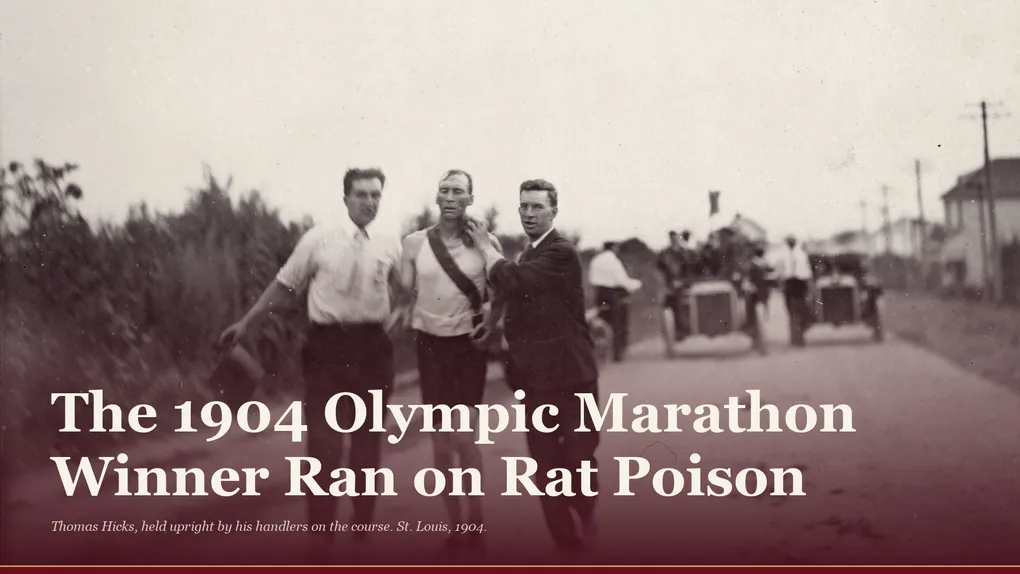
Thomas Hicks was an English-born brass worker out of Cambridge, Massachusetts, and with ten miles to go he was leading the race and coming apart at the seams. He asked his handlers for water. Nope. They handed him about a milligram of strychnine sulfate, whisked into a raw egg white.
Yes, that strychnine. You know, rat poison. In tiny amounts it can work as a stimulant. In slightly less tiny amounts it’s the reason you no longer have a rat problem.
He perked up. Then he faded again, so they gave him a second dose, this time with brandy. Doctors figured later that a third round probably would have killed him.
By the time Hicks reached the stadium, he was ashen, hallucinating, and convinced the finish line was still twenty miles away. His trainers essentially held him upright and walked him across while his feet paddled the air underneath.
He lost eight pounds during the race. Four doctors worked on him afterward. His time, 3:28:45, is still the slowest winning marathon in Olympic history by almost half an hour, and it stands as the first documented case of “performance” drugs at the modern Games. It does make you wonder if performance-degrading drugs are technically illegal.
Meanwhile, Back in the Car
Lorz cramped up around mile nine, flagged down one of the automobiles, and climbed in. Around mile nineteen, the car broke down, which left him feeling refreshed and standing about five miles from glory, so he hopped out and jogged the rest of the way in.
The crowd went nuts as he broke the tape. He got his photograph taken with Alice Roosevelt, the President’s daughter. He was seconds away from having a gold medal hung around his neck when spectators who had seen him riding by in the backseat started complaining.
Lorz said the whole thing was a joke. The AAU banned him for life, then unbanned him about a year later, and he won the 1905 Boston Marathon. We think that one was actually on foot.
The Cuban Mailman Who Stopped for a Nap and Still Beat Almost Everybody
Félix Carvajal was a postman from Havana who raised his travel money by running exhibition laps in public for donations, then lost it all shooting craps in New Orleans. He hitchhiked the rest of the way to St. Louis and showed up at the start line in street shoes, long dress trousers, and a beret.
Seeing a fellow athlete in need, an American discus thrower named Martin Sheridan found a pair of scissors and cut Carvajal’s trousers off at the knee.
Carvajal hadn’t eaten in something like forty hours, so he grazed his way down the course. Most accounts have him raiding an orchard for apples. It seems the apples were rotten, which caused some serious stomach cramps. That led to Carvajal taking a nap beside the road.
He woke up and resumed the race, finishing fourth.
The Dogs
Len Taunyane and Jan Mashiani were two Tswana men from South Africa who happened to be in St. Louis as part of the World’s Fair’s Boer War exhibit. They were not athletes but entered the marathon anyway and became the first Black Africans to compete in the modern Olympics.
Taunyane finished ninth, which is impressive on its own. What’s even more impressive is that he’d been chased nearly a mile off the course by a pack of dogs. Mashiani came in twelfth. Both men ran barefoot or close to it. Reporters at the time wondered out loud what those two could have done with shoes and actual training.
And Someone Nearly Died
William Garcia of California was found lying beside the road and rushed to the hospital with internal hemorrhaging. The dust he’d been swallowing for hours had shredded his stomach lining. He came uncomfortably close to being the first man to die at a modern Olympic Games.
The spectacle was such a debacle that serious people argued the marathon should be thrown out of the Olympics for good. Instead, London standardized the distance in 1908 at 26.2 miles, mostly so the race could start at Windsor Castle. As we now know, the marathon went on to become the “crown jewel” of the modern Olympics.
As for Hicks, he said afterward that he’d rather have won that race than be President of the United States.
He also said he never wanted to run again. Smart man.