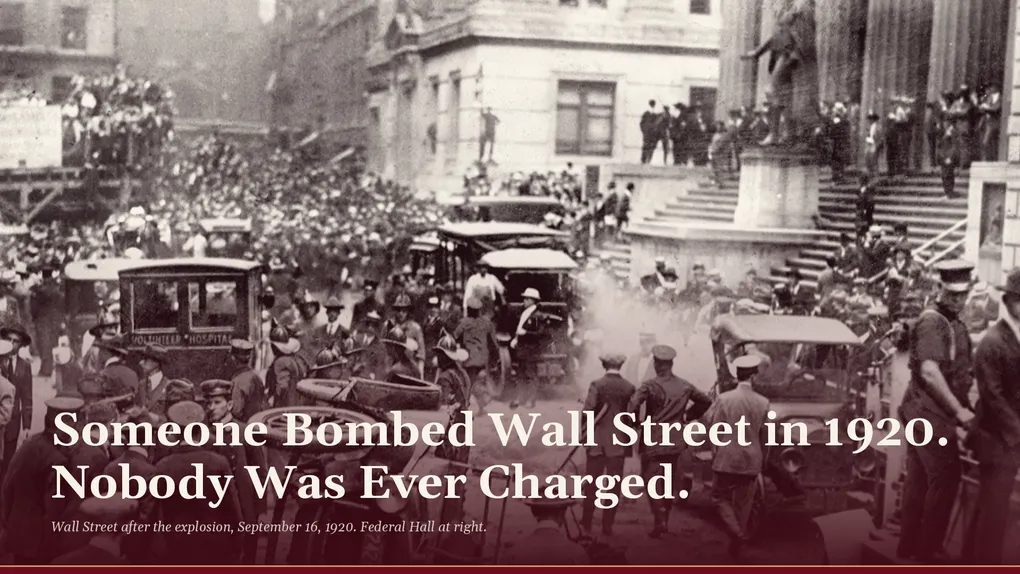
Someone Bombed Wall Street in 1920. Nobody Was Ever Charged.
Walk past 23 Wall Street and take a close look at the stone. The facade has pockmarks and gouges. Like little craters, as if somebody took a ball-peen hammer to it.
But it wasn’t an ill-tempered pedestrian with a bashing tool. Those marks go back to a September day in 1920, and according to recent reports and photographs, they’re still present. Who caused it remains a mystery: more than a century later, nobody has ever been charged.
Back then, 23 Wall Street was home to J.P. Morgan & Co. Across the street stood the U.S. Assay Office, where the government weighed and tested gold and silver. Money talked on this particular block.
On September 16, 1920, at about noon (most accounts say 12:01 p.m.), a horse-drawn wagon sat on Wall Street in front of the Assay Office, across from the Morgan bank. It was lunch hour. The sidewalks were packed with people heading out for a sandwich and a break in the fresh air.
Then the wagon exploded.
It turns out the bomb was packed with iron window sash weights. If that doesn’t sound familiar in this day of double-paned, magic sliding glass, those weights served as the counterbalance to hold a window part-way open. They were made of iron and quite heavy, as you might imagine, having to win the struggle between gravity and heavy windows. A few hundred pounds of sash weights surrounding high explosive material is a recipe for lots of damage to things and people alike.
As for the explosive part, the details depend on who you ask. Some accounts put it at about 100 pounds of dynamite and 500 pounds of iron. Britannica says it was TNT. The FBI says investigators at the time argued about the type of explosive.
The blast killed 38 people and injured hundreds more. The casualty list reflected the staff of any busy office: clerks, stenographers, brokers and messengers. Basically, folks who came to work that morning and stepped outside for lunch.
A Pennsylvania Railroad telephone memo from that day blamed the blast for a still-hot piece of iron that damaged the ferry Washington at Cortlandt Street.
The aftermath was surprising to say the least. Wall Street opened for business as usual the next morning. Injured workers showed up with bandages while blown-out windows had been covered up. That afternoon, a crowd gathered and sang patriotic songs.
It’s hard not to admire the grit and “don’t let the bad guys disrupt our life” mentality. However, there was a price. Crews had worked through the night cleaning up the damage. As the FBI put it, “Crews cleaned the damage up overnight, including physical evidence that today would be crucial to identifying the perpetrator.”
So investigators started with a distinct lack of raw evidence.
The most promising lead came from the mail. A letter carrier had turned up four printed flyers from anarchists demanding the release of political prisoners. Once investigators peeled back layers, suspicion fell on followers of the anarchist Luigi Galleani, a group already on the government’s radar.
Suspicion is the easy part. Proof is another level. According to the FBI, investigators couldn’t make the case stick. Years of digging, eleventy-nine thousand interviews (OK, it was hundreds, but that’s still a lot of shoe leather), and the case was no closer to a courtroom.
Decades later, some investigators pointed to a man named Mario Buda as a likely suspect. One theory holds that the bombing might have been payback for the indictment of Sacco and Vanzetti, two Italian anarchists charged with murder in Massachusetts earlier that month. It’s a possibility, and historians aren’t in agreement on the theory. Nobody has ever proven who planted the bomb, and nobody has ever stood trial.
Now back to the wall.
Why didn’t anyone just patch the holes? The traditional explanation says the marks stayed as a badge of honor, a sort of “you didn’t knock us down” permanent message. There’s also a less dramatic theory, that fixing the facade would have been more trouble than it was worth.
Thirty-eight people died that day and nobody went to trial. The only one who knows is the wall, and while it’s still there, it’s not talking.