How a Washington Snub Helped Break Up Andrew Jackson's Cabinet
The biggest shake-up of Andrew Jackson’s first term didn’t start on the floor of Congress. It started with a drama over guest lists. You know, who called on whom and who got invited to something, and who didn’t.
Margaret “Peggy” Eaton grew up in Washington, where her father ran a boardinghouse and tavern. Her first husband, John B. Timberlake, served as a navy purser and died at sea. About nine months later, on January 1, 1829, Margaret married John Eaton. He was one of Jackson’s closest friends from Tennessee, an old military comrade, and the man who had already written Jackson’s biography. When Jackson took office that year, he made Eaton his Secretary of War.
And yes, if you were wondering about the nine-month mourning period, that was considered perhaps a “bit too quick”, even for the times, and especially by hoity-toity Washington standards. Rumors had been circulating that maybe Margaret and Eaton had a little thing going prior to her first husband’s death. He was away at sea after all…
So, based on nothing but rumors and “judgy-ness,” the wives of Jackson’s cabinet members shunned her. Floride Calhoun, wife of Vice President John C. Calhoun, joined in, and she didn’t exactly keep it quiet. Even Emily Donelson, a relative inside Jackson’s own household, refused to associate with Margaret. This all might sound petty, but you know how Washington runs. It’s all about the backroom relationships and associated wheeling and dealing. So, the social events calendar was an important power lever. Snubs like this were a big deal.
Jackson took it personally. His wife, Rachel, had died before he took office. As the wife of a politician, she’d taken plenty of beatings in the public eye, and Jackson was of the opinion that the attacks had contributed to her early death. So when round two started with Margaret, he was reliving round one. Not good.
Jackson started to see a plot against his administration, and eventually he blamed Calhoun. Here’s the thing, though: Jackson and Calhoun already had plenty to fight about. Calhoun had criticized Jackson’s earlier military push into Florida, and the two had some bad blood over the nullification debate over whether states had the ability to overrule federal law.
Martin Van Buren was then Secretary of State and a widower, so he wasn’t as directly involved in the social snubbing. He treated Margaret just fine and invited her to his functions. He also got on fairly well with Jackson politically.
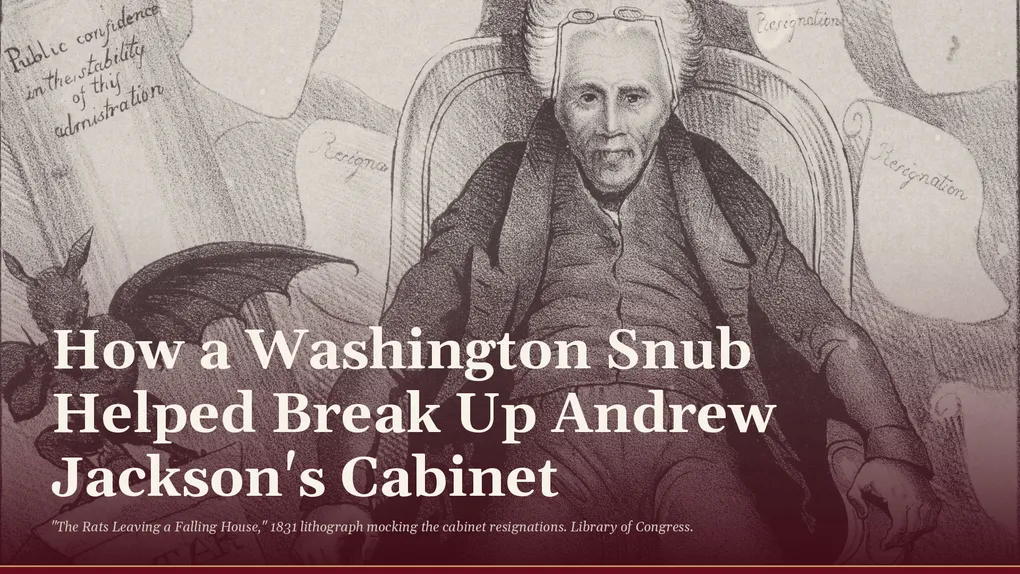
By 1831, the cabinet was grinding to a halt from all the peripheral pettiness. Jackson and Van Buren used to talk things over on horseback, and during one of those rides they planned their strategy to break the deadlock. That spring, Van Buren and Eaton both resigned voluntarily. Their departure cleared the way for Jackson to do additional house (cabinet) cleaning. Samuel Ingham left the Treasury. John Branch left the Navy Department. John Berrien left the attorney general’s office. Only Postmaster General William Barry stayed, and he kept that job until 1835. Calhoun, as vice president, stayed put too.
The media had some fun with all this. For example, a lithograph by Anthony Imbert called “The Rats Caught” made fun of the whole breakup and labeled Van Buren “The Magician.”
That didn’t end the drama. Jackson nominated Van Buren as minister to Britain. In early 1832, the Senate confirmation vote came down to Calhoun, who cast the deciding vote against him. If Calhoun meant to sink Van Buren, it backfired because Van Buren emerged as a political martyr of sorts. Jackson picked him as his running mate, and Van Buren was elected vice president in 1832. Four years later, he became president.
Calhoun ended up in decent shape, too, when all the dust had settled. Jackson had already picked Van Buren for his next running mate, and Calhoun had nothing left to lose. After winning a Senate seat in December 1832, he resigned the vice presidency before his term was due to end in March 1833. He was the first Vice President to resign while in office.
Clearly there was a lot more going on here than social snubbing by Washington society wives, but banishment from the cocktail and dinner circuit must have had something to do with the subsequent drama.
I’m pretty sure the saying, “Hell hath no fury like a woman scorned,” had a completely different origin story, but apparently that fury can rub off on the husband.