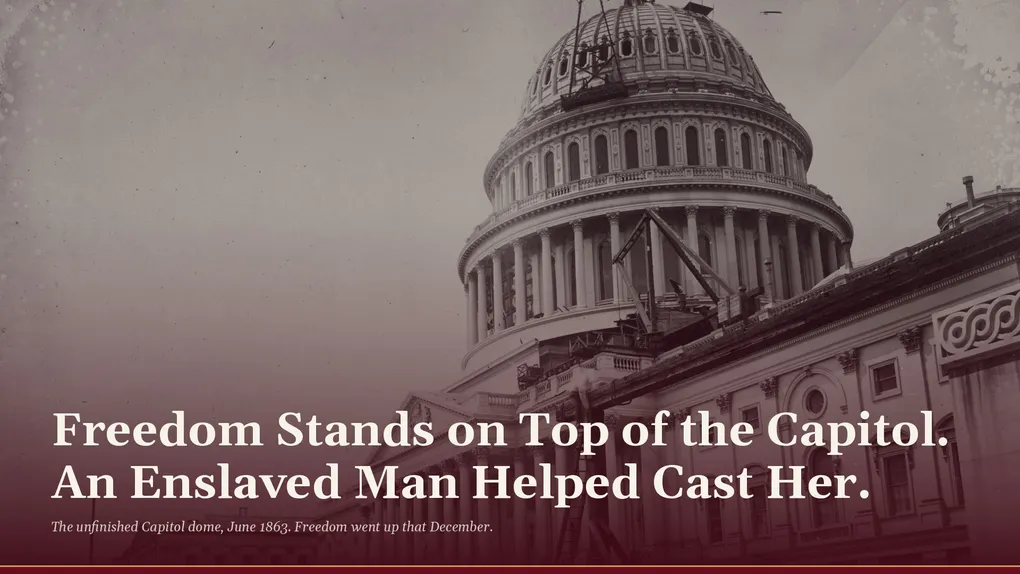
Freedom Stands on Top of the Capitol. An Enslaved Man Helped Cast Her.
The federal government paid $1.25 a day for his work. For six days a week, that money went to the man who owned him. On Sundays, it went to him.
His name was Philip Reid. Some of the old records spell it Reed, so don’t get too upset with the storyteller here (that’s me). He was born around 1820, and in the late 1840s a sculptor named Clark Mills brought him from Charleston, South Carolina, to Washington. Mills had a big job lined up, the bronze Andrew Jackson on a rearing horse that still stands across from the White House, and Reid worked on it alongside Mills and the rest of the crew. By the time the next big job came along, he knew his way around a foundry. Nobody knows what he looked like. No photograph or portrait of him has ever turned up as far as we know.
Freedom Wardrobe Troubles
That next big job was Freedom. Thomas Crawford, an American sculptor working in Rome, designed her for the top of the new Capitol dome: a classical female figure, 19 feet 6 inches of bronze.
Crawford’s second design gave her a liberty cap, the soft cap ancient Rome used to mark a freed slave. The man overseeing Capitol construction at the time was the Secretary of War, Jefferson Davis, and Davis objected. He didn’t care for the cap’s connection to freed slaves and argued it was “inappropriate to a people who were born free and should not be enslaved.” Crawford swapped it for a helmet topped with an eagle’s head and feathers. The final design got approved in April 1856.
So the statue called Freedom lost her freedom cap. Hold that thought for a hot second.
Things Get Fuzzy
Crawford died in 1857 without ever seeing her cast. His plaster model left Rome in the spring of 1858, packed in six crates, and the ship leaked, stopped at Gibraltar, and gave out for good at Bermuda. The crates sat there until other ships could haul them, and the last pieces reached Washington in late March 1859. An Italian craftsman put the five sections together in the old House Chamber (today’s Statuary Hall) and smoothed over the joints so the model looked like one solid piece.
That smoothing job is where the story gets interesting, and where the historians have some disagreement.
The Architect of the Capitol tells it this way. In 1860, the time came to take the model apart so Mills could cast it in bronze at his foundry outside the city. The craftsman who had assembled the model got into a dispute over pay, and the seams he had hidden so carefully now had to be found. The fix was credited to Reid: rig a pulley and tackle to the lifting ring on top of the model, pull, and watch for the seams to show themselves under the strain.
The other side of the story goes like this. The White House Historical Association ran an article on Reid and later went back and revised it. It now says the story of Reid “saving” the statue is likely embellished, and it points readers to a 2022 book by historian Erin L. Thompson called Smashing Statues. That doesn’t mean Reid didn’t work on the model, or that he wasn’t a skilled hand on the job. The payroll sheets prove he was plenty involved. It means the dramatic version, the one where everything hangs on one clever man and a rope, may have been embellished a bit in the retelling. That’s the interesting part of history like this. The stories can be a bit fuzzy around the edges.
The Payroll Doesn’t Lie
The paper trail is less dramatic and more telling. The government paid $1.25 a day for Reid’s labor. Other laborers on the list got a dollar. Mills collected Reid’s wages Monday through Saturday. Sunday was different. From July 1, 1860 through May 16, 1861, Reid worked 33 Sundays, “Keeping up fires under the moulds,” and collected $41.25 for it himself. He signed with an X.
Reid Freed, Now Reed
The casting was finished in 1862. Reid didn’t see the job through as an enslaved man, because on April 16, 1862, President Lincoln signed the D.C. Compensated Emancipation Act and freed everyone held in slavery in the District. That was about nine months ahead of the Emancipation Proclamation. The “compensated” part meant former owners could file a claim for payment from the government. Mills filed. His petition, sworn June 18 and filed June 20, 1862, lists Reid at age 42, notes the $1.25 government pay rate, and describes him as “smart in mind, a good workman in a foundry.”
On December 2, 1863, workers raised the last section, the head and shoulders, onto the dome. A 35-gun salute went up from the Capitol grounds, one for each state at that time, and the Senate’s historians note that count included the states then in rebellion. Twelve forts around the city answered. Reid was a free man that day. Whether he was present or not for the ceremony, no one knows.
Two years later, a writer named S. D. Wyeth put out a guidebook to Washington called The Federal City and gave Reid one line: “Mr. Reed, the former slave, is now in business for himself, and highly esteemed by all who know him.” Mills’s petition spelled it Reid. Wyeth spelled it Reed. Reid signed his payroll with an X, so nobody knows which one he’d have picked.
Freedom took her place on the dome in December 1863. Philip Reid beat her to it by about 20 months.