Franksgiving: The Year Half of America Celebrated a Week Early
For years, Americans couldn’t agree on what day to celebrate Thanksgiving. When you think about it, there’s a lot riding on this: family gatherings, travel, and most importantly, football games. They say everything’s bigger in Texas, so in that state people said, “Why not both dates?”
For want of an official date
Here’s the thing. Thanksgiving didn’t always have an officially designated date. It was Lincoln’s proclamation in 1863 that encouraged the last Thursday in November. Most people rolled with that day. But then 1939 came along and threw a wrench in the system. Five Thursdays that month, which put Thanksgiving on November 30th.
Sure, the last day of the month seems a little awkward, but the real problem was the retail impact. The country was still recovering from the Great Depression and retailers didn’t want to delay the beginning of the “Christmas rush” until the very last day of November.
Business first?
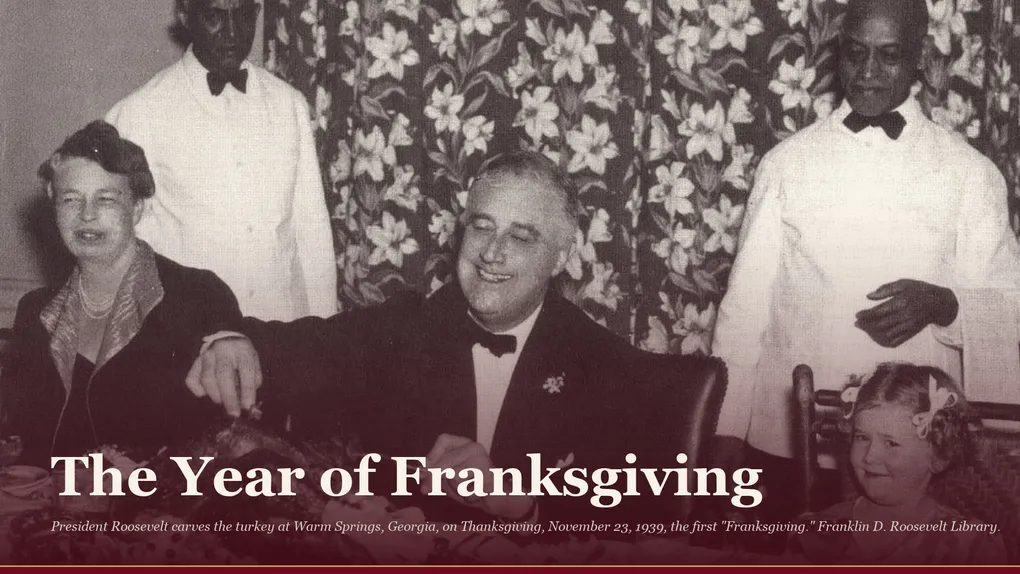
It was Fred Lazarus Jr., head of Federated Department Stores (the company that later became Macy’s), who pressed President Franklin Roosevelt to move the official holiday a week earlier. Based in part on a government memo warning of a slow holiday shopping season, FDR bought into the idea.
He communicated the idea to the American people at the end of a different press conference. He claimed there was “nothing sacred” about the date and announced Thanksgiving would be on November 23.
“Not so fast,” said a whole lot of folks.
Presidential authority limited this holiday shift to federal workers and residents of the District of Columbia only. States and their respective Governors had authority to determine what went down across the country.
Dissension in the ranks
The rough math of agreement with the federal plan netted out to about fifty-fifty going with the new date versus the last Thursday option. The Mayor of Atlantic City, Charles White, named the new option “Franksgiving,” and that became the early 20th-century version of an internet meme, spreading like wildfire.
In general, the loudest opponents were in New England. Think Plymouth Rock territory. In fact, the chairman of the Plymouth selectmen said he “heartily disapproved.” Alf Landon, who’d lost to Roosevelt in 1936, chalked the plan up to FDR’s “impulsiveness.” A Gallup poll claimed 62 percent of Americans were opposed to the date switch.
College football had something to say as well. The traditional rivalry games were booked for the last Thursday of November, and teams had built entire seasons around that date. Even then, schedules were planned well in advance. If Thanksgiving was rescheduled, then those matchups would be taking place on a random Thursday. Less than ideal.
Texas being Texas…
And then Texas weighed in. Governor W. Lee “Pappy” O’Daniel favored doing both and kept the last Thursday in honor of the “Pilgrim fathers,” and then pointed out Texans could “very well observe two days of thanksgiving.” Why not? Everything is bigger in Texas, even Thanksgiving. Federal offices and stores closed on FDR’s date. Schools and state colleges closed on the Texas date. That kept the Texas vs. Texas A&M game right where it belonged according to the original schedule. It was a good year to be a Texas state employee: they got both days off.
Those in the business of selling turkeys were just fine with the plan. Texans called the second date “States’ Rights Thanksgiving.” Colorado and Mississippi doubled up, too, but Texas seemed to get the attention.
All about… nothing really
So, what was the end result on retail sales? That was the factor underlying all the chaos. As it turned out, a 1941 Commerce Department survey found no significant bump in retail sales. New York Mayor Fiorello La Guardia said store owners saw no gain and lots of hard feelings, “much of it sentimental.”
Thankfully, this national crisis was resolved in 1941. Since this had never been written into actual law, Congress acted and made things official, with a twist. When Roosevelt signed the resolution on December 26, 1941, the law defined the Thanksgiving holiday as the fourth Thursday in November. You have to admit that was a nifty dodge to solve the fifth Thursday “problem.”
Once again, “not so fast, my friend.” Texas held out. In five-Thursday years, the Lone Star State kept celebrating twice. That lasted until 1956, when a state legislator asked his colleagues, “Don’t you think if Texas holds the line, the other states will come along with us?”
It was not to be. Texas finally changed its law in 1957 to line up with the rest of the country.
So there you have it. Black Friday happens anywhere from November 23 to November 29. You can blame, or thank, a department store executive and FDR.