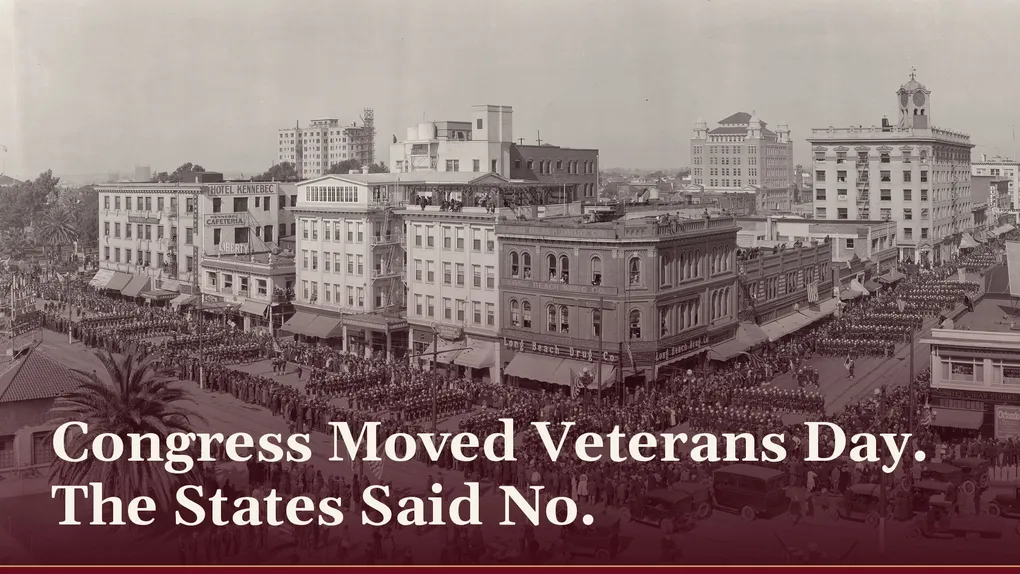
Congress Moved Veterans Day. The States Said No.
From 1971 to 1977, the federal government held Veterans Day on a Monday in October, under a law that moved four holidays to Mondays. Most states ignored the change, and Congress finally moved it back to November 11.
Let’s start with a pop quiz: when is Veterans Day?
If you answered November 11, you just earned a cookie. A couple of states never stopped agreeing with you, even when Washington moved it, and they started a revolt that eventually won the date back.
Back in the 70s, the federal government officially moved Veterans Day to the fourth Monday in October. The plan didn’t go over well. To understand why, we have to back up some and dig into the story. Here goes.
What’s Special About November 11th?
The meaning behind the date goes back to World War I. The war wasn’t “officially” over until the Treaty of Versailles was signed in June of 1919. However, the shooting part ended with an armistice beginning at 11 AM on November 11, 1918. The eleventh hour of the eleventh day of the eleventh month. You have to admit, it’s easy to remember. Hold that thought for a second.
One year later, President Woodrow Wilson proclaimed the first Armistice Day. The idea behind the commemoration was to have parades, public gatherings and a national business pause for two minutes starting at 11 AM. Imagine the entire country stopping in their tracks at the same moment.
Then, two years later, the date took on even more meaning. On November 11, 1921, an unidentified American soldier, brought home from France, was buried at Arlington National Cemetery. He became the very first Unknown Soldier. In remembrance, Congress made that one day a federal holiday to honor all Americans who served in World War I.
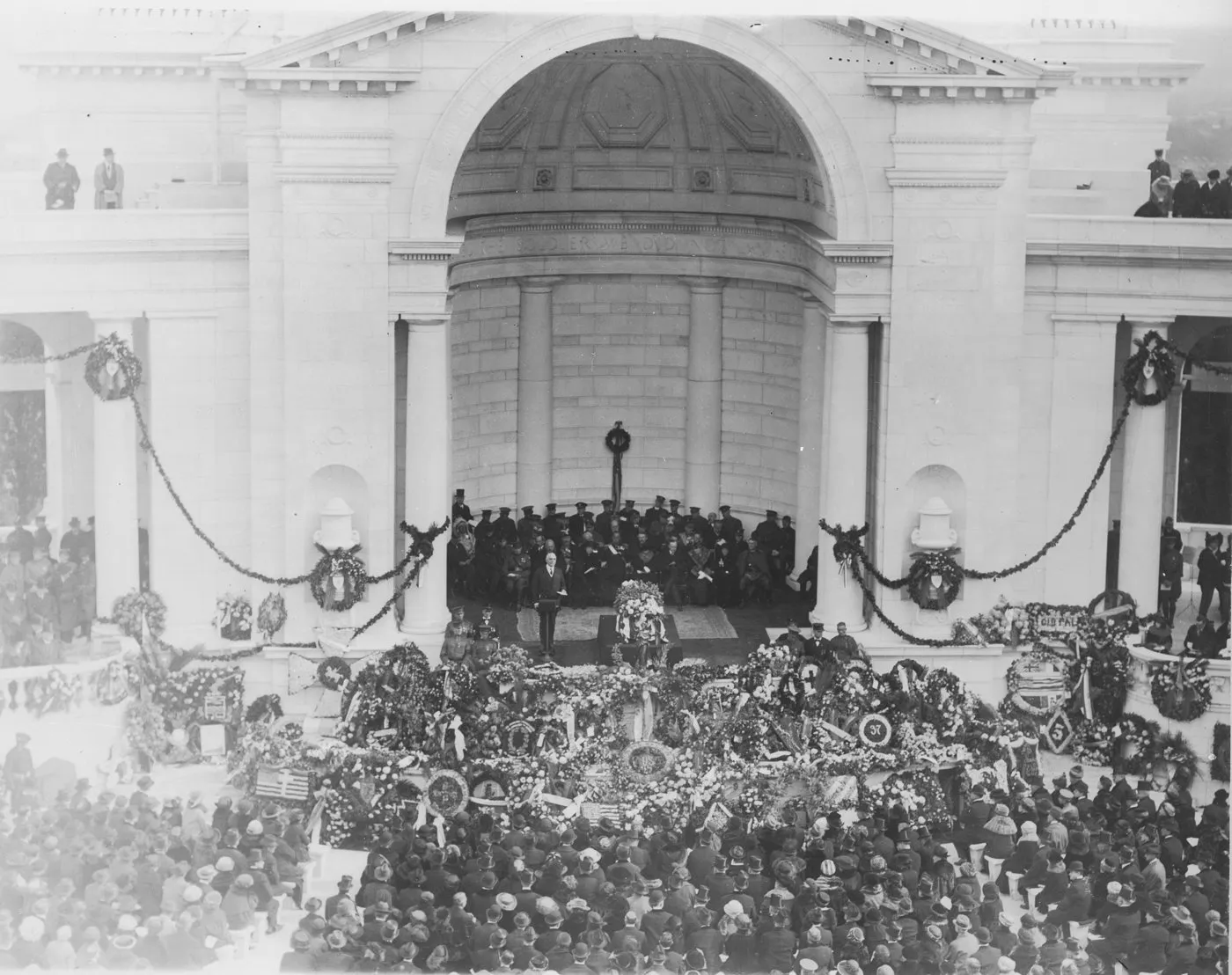 President Warren Harding stands beside the casket at the burial of the Unknown Soldier, Arlington National Cemetery, November 11, 1921.
In 1938, Congress did some fine-tuning on the holiday and declared Armistice Day a legal holiday “dedicated to the cause of world peace.” The message didn’t make it across the pond because less than a year and a half later, Germany invaded Poland, kicking off the Second World War.
A World War II Veteran Calls for Inclusion
Navy veteran Raymond Weeks returned home to Birmingham, Alabama, after serving in World War II and noticed that Armistice Day only honored veterans from World War I. Weeks was just one of millions of freshly minted veterans who had served in a new World War.
On November 11, 1946, Weeks approached General Dwight Eisenhower with an idea to upgrade Armistice Day into a National Veterans Day for everyone who served in the armed forces. Eisenhower liked the idea, but making the plan official would be up to Congress. Weeks didn’t wait for that sloth-like machinery to get around to creating Veterans Day, so he staged the first one himself in 1947. Birmingham recognized veterans with a parade and a banquet.
Then Kansas congressman Ed Rees joined the project with the simplest bill ever. It changed just one word in the existing 1938 law. The word “Veterans” was proposed to replace the word “Armistice.” Simple enough for even Congress to understand. And they did, sending the bill to Ike, who signed it on June 1, 1954. Weeks’ pitch seven and a half years earlier had come full circle, and the job was done.
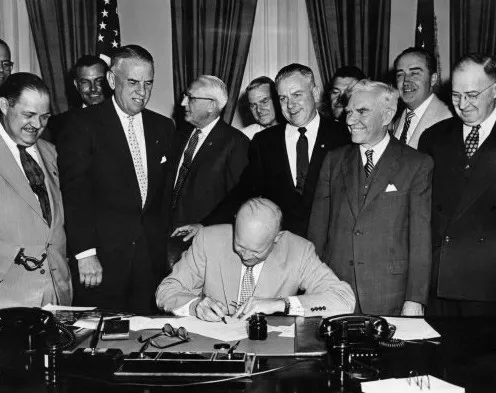 President Eisenhower signs the bill that turned Armistice Day into Veterans Day, June 1, 1954. Rep. Ed Rees of Kansas is among the men looking on.
Weeks continued to drive the Veterans Day commemorations in Birmingham every year until his death in 1985. In 1982, President Ronald Reagan presented him with the Presidential Citizens Medal and called him “the driving force behind the congressional action which in 1954 established this special holiday.” Reagan continued, “Your country is mighty grateful for what you’ve done.”
Why Move Veterans Day to October?
In 1968, Congress passed the Uniform Holiday Bill, which relocated four holidays to always be observed on Mondays: Washington’s Birthday, Memorial Day, Columbus Day and Veterans Day. According to the VA’s own history, the idea was that establishing long weekends “would encourage travel, recreational and cultural activities and stimulate greater industrial and commercial production.”
Under the new plan, Veterans Day would be observed on the fourth Monday every October. The first one on the new schedule fell on October 25, 1971. The VA’s own history said it came and went “with much confusion.”
Holiday Secession
We have to do a quick diversion on how holidays work. Washington only sets holidays for federal workers and the District of Columbia. While states usually follow the Washington schedule, they are able to choose their own.
Two states, Mississippi and South Dakota, never switched their Veterans Days. Louisiana and Wisconsin followed the national plan for a couple of years, but reverted to November 11th in 1972. Seven additional states flipped back in 1974, and a lot more followed suit in 1975. Being a South Carolinian, I’m kind of proud that the Army’s official list indicates that South Carolina switched back twice. I have no idea what that means, but it sounds bold.
Following the wave of rebellion, by 1975, 46 states had either remained with the November 11th or switched back to it. The feds were basically hosting an event that few outsiders chose to attend. And veterans groups were kinda hot about the whole thing.
Finally, Congress took the hint. Colorado’s Patricia Schroeder led the effort in the House, and New Jersey’s Dominick Daniels summed up the situation: “I believe there is still room for tradition in this society, even as we race forward toward the 21st century.” The House bill passed 410 to 6. The vote count shows what a no-brainer the movement was, and President Gerald Ford signed it into law in September 1975. By 1978, the federal Veterans Day was back on November 11.
Of course, Washington’s Birthday, Memorial Day and Columbus Day still occur on Mondays. Of the four, only Veterans Day got its original date back.
Eleventh hour, eleventh day, eleventh month. It’s easy to remember and, apparently, hard to move.