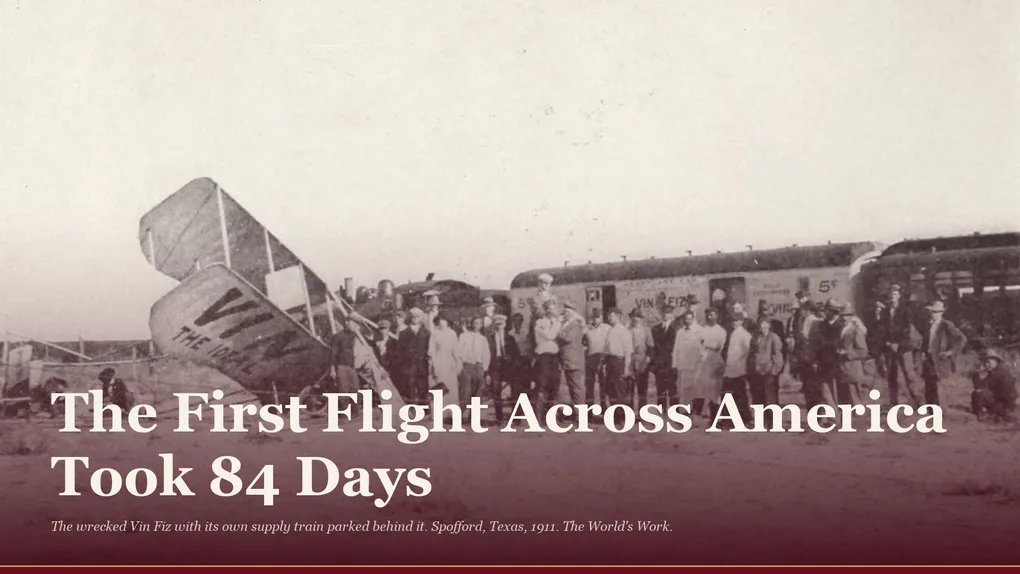
A Grape Soda Paid for the First Flight Across America. It Took 84 Days.
Next time you’re wedged into seat 34B with your knees against the tray table, listening to the guy two rows up narrate his fantasy football draft to an audience held hostage by chairs too small for the adult human body, ponder this.
You are crossing the United States in about six hours. Sitting down. With a beverage.
The first man to do it took 84 days. He was mostly deaf. He had roughly ninety minutes of flight instruction. And a grape soda bankrolled the whole operation.
His airplane didn’t exactly make it either. Most of it is still out there, scattered across America in pieces.
Cash Speaks
Back in 1910, when Vaudeville and Nickelodeon movies ruled the earth, William Randolph Hearst (the newspaper tycoon) offered a whopping $50,000 (more than $1.6 million today) to the first person to fly across the United States. The rules were simple. You had to fly coast to coast in less than 30 days. Yes, you read that right.
Wilbur Wright said the person who pulled it off would be “exceptional, physically and intellectually,” and would need “every atom of courage in his make-up.”
Enter Calbraith Perry Rodgers.
Cal was six foot four, raced motorcycles, sailed boats fast, and came from a family that had been producing famous naval officers for a century. The classic daredevil type. A childhood run-in with scarlet fever had left him deaf in one ear and barely hearing in the other. He enrolled in about ninety minutes of flight instruction from Orville Wright in the summer of 1911, soloed, and picked up pilot’s license number 49 in August. That’s the forty-ninth issued in the country, to be clear.
About a week later, he decided he’d like to fly across a continent.
To be fair, two other men were trying that same September. Robert Fowler launched from San Francisco and gave up after the Sierras beat him three separate times. James Ward took off from the East Coast and quit about a week later without managing to leave New York State.
With the competitors dropping like flies, Cal was the last pilot in the running.
A Flying Billboard
Airplanes were expensive. Rodgers was not independently rich enough to eat the cost, so he went looking for a sponsor and found J. Ogden Armour, a wealthy Chicago meatpacker, who happened to be launching a new grape soft drink called Vin Fiz.
Armour would pay Rodgers five bucks for every mile he flew east of the Mississippi and four for every mile west of it. Armour would also supply a train. In exchange, Rodgers would paint VIN FIZ on his wings and fly America’s first airborne advertisement across the country.
The soda itself was a hot mess. People knew the name, tried it once, and declined a second helping, so before long Vin Fiz soda took its rightful place in the graveyard of rotten product ideas. At least the airplane named after it hangs in the Smithsonian.
The Train Was the Plane
Rodgers understood something most pioneers figure out the hard way: the airplane was going to break. A lot. So Armour sent a special train down the rail line beneath him, and that train did the actual work of getting the Vin Fiz aircraft, and hopefully its pilot, to California in one or more pieces.
Cal’s wife Mabel and his mother rode the train. It also carried reporters and Armour publicity men. It even had a specially-equipped hangar car, a rolling machine shop stuffed with spare struts, wire, fabric, and engine parts. And it carried Charlie Taylor, the Wright brothers’ own mechanic, the man who had built the engine for the airplane at Kitty Hawk, hired at seventy dollars a week to patch up the plane along the way.
They painted the roofs of the rail cars so Rodgers could spot them from the air because the Vin Fiz didn’t even have a compass on board. Yes, you’re reading this correctly. Rodgers navigated by following the train below. More than once, he picked the wrong train or tracks.
He crashed (the first one) on day two when he hit a tree taking off from Middletown, New York. The plane ended up in a chicken yard, and Taylor needed three days to rebuild it.
Blown Deadline
By the time Hearst’s 30-day challenge ran out, Rodgers was in Kansas City. The $50,000 was off the table, and everyone knew it. Cal continued the journey anyway.
Over the next several weeks, the Vin Fiz made 75 stops, suffered at least a dozen crashes (most claims were that it was about sixteen) and four engine explosions. Rodgers got hurt repeatedly and got back in. Taylor and his crew rebuilt the airplane so many times that when it finally reached the Pacific, only a handful of original pieces had made the entire journey. The rudder. Part of the wing structure. A few odds and ends.
Everything else was replaced somewhere between Brooklyn and the ocean. The Vin Fiz that landed in California was, in a very real sense, not the airplane that left New York. It was a flying collection of every repair Charlie Taylor made in a boxcar.
Crutches, Compton, and the Pacific
At 4:04 in the afternoon on November 5, Rodgers put down at Tournament Park in Pasadena, 49 days after leaving Sheepshead Bay. A crowd of twenty thousand was waiting for him.
Officially, he’d succeeded with the coast-to-coast trip, but the actual ocean was still about 20 miles west. The city of Long Beach offered him a thousand dollars to bring the airplane all the way there, so he took off one more time and promptly crashed again at Compton. Cal suffered a concussion and twisted spine and spent weeks in a hospital.
On December 10, he came back and finished the flight. He couldn’t walk unassisted, so they lashed his crutch to the wing, flew the last few miles, landed on the beach, and rolled the Vin Fiz into the Pacific until the water was touching the skids.
The final numbers: 4,321 miles. Eighty-two hours and four minutes of actual flying time. Eighty-four calendar days.
The next time you complain about a long layover, consider spending the night somewhere after each hour of flight!
The Future: Three Days!
Rodgers had a line he liked to give reporters. “I expect to see the time when we shall be carrying passengers in flying machines from New York to the Pacific Coast in three days.”
He didn’t live to see any of it. On April 3, 1912, four months after the surf at Long Beach, Rodgers was flying an exhibition over that same beach when he flew into a flock of gulls. The controls got jammed, and his plane crashed into the water less than a hundred yards from where he’d finished the greatest flight of his life. He was thirty-three, and he became the first person in history killed by a bird strike.
The Vin Fiz outlived him. The Smithsonian acquired it in 1934, and it hangs in the National Air and Space Museum today, labeled as the first airplane to cross the United States.