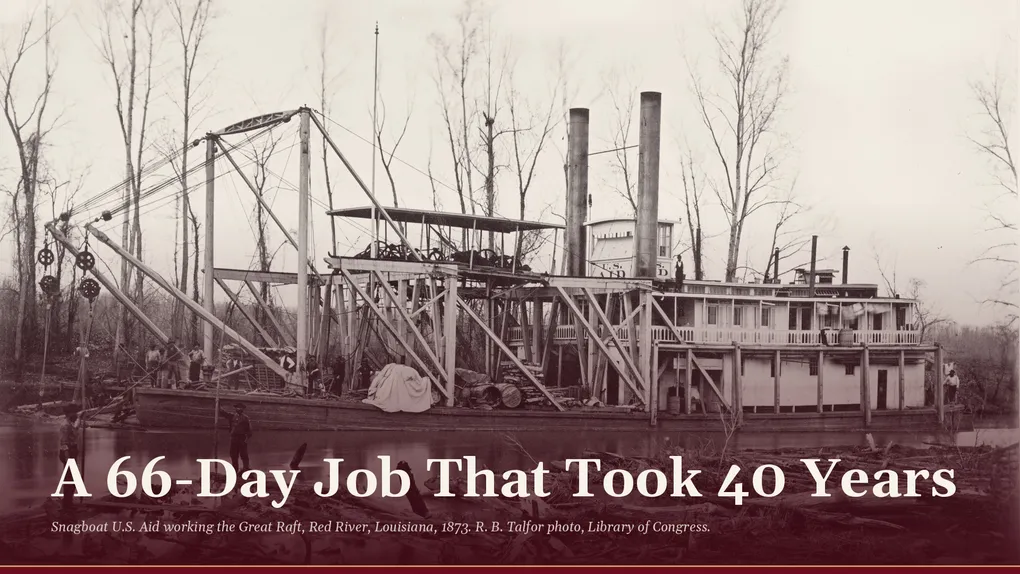
A 66-Day Job That Took 40 Years
Henry Shreve was just a bit optimistic.
He looked at the biggest log jam in North America (Yes, you read that right. I know it’s a problem few of us can relate to.) and figured he could knock it out in about two months.
That was back on April 12, 1833, and Henry had been working this particular problem just one day. So far, remember, just one day, he and his workers had already cleared five miles of logs from the Red River in Louisiana. Based on the early success, he wrote his bosses that he had “no doubt but I could remove the whole raft in sixty-six days.”
I said something like that when I built an 800-square-foot stone patio by myself. Many tons of limestone foundation, thousands of heavy stones, and I don’t know how many weeks later, my back would call foul on my optimistic outlook.
A Log Jam with an Attitude
The Red River comes down out of Texas and Oklahoma, crosses Louisiana, and empties into the Mississippi. For centuries, miles and miles were obstructed. Trees from the banks fell into the river and got all tangled up with more trees. Over time, all this detritus piled up. Eventually, the “clog” extended for over 100 miles. People called it the Great Raft.
In fairness, it wasn’t an uninterrupted 100-mile stretch of log jam. It was more like dozens of separate ones. But many of them trapped other river debris and even silt and mud. Parts of the mess kinda turned into “forest” (or maybe more like swamp) with new growth sprouting out of the mess. In these sections, one could walk or even ride a horse right over, having no idea there was a river underfoot.
To top things off, the whole lot of it also moved. While the downstream sections eventually rotted away, the upriver parts collected fresh replacement debris. The effect was that the log jam “moved” north a little more each year.
However, the water did what it does and kept flowing by finding new paths of lesser resistance. New ponds and lakes, like Caddo Lake, formed.
Hold that thought for a hot second.
”Uncle Sam’s Toothpullers”
It was clear a major clearing job was in order, and Henry Shreve was the right man for the job. He’d spent years clearing snags out of the Ohio and Mississippi, and he’d invented a proven tool to clear precisely this type of mess efficiently: the snagboat. Maybe he should have called it the “unsnag” boat, but who are we to question? It was made with two steamboat hulls fastened together, side by side, with a heavy beam between them and a steam winch up top. The idea was to ram a sunken tree, hook it, haul it up, cut it up into pieces, and let the current carry off the scraps. People called these battering ram boats Uncle Sam’s Toothpullers.
Shreve took on the clearing job with four of these boats and 159 men. Four weeks in, he’d cleared about forty miles. Ponder that for a sec. This was early 1800s. Henry’s sixty-six-day estimate was looking realistic.
And then reality struck.
Each spring, floods would carry boatloads of new trees and debris downriver and create new jams right behind the working crews. Frustrating, I’m sure. And the upper sections were older, denser, and meaner. One thirty-mile stretch took longer than the first hundred miles put together.
And to compound matters, Congress sent less money than Shreve had asked for. Imagine that.
He got through in the spring of 1838. If you’re keeping count, the 66-day job took about five years.
Shreve asked Congress for $30,000 to maintain the now-cleaned-up river by keeping patrol boats so the raft couldn’t grow back. Congress didn’t bite on that plan, so by the summer of 1839, the log jam was back.
At least Shreve got a consolation prize. The town you’re now thinking of was named after him.
Blowing Stuff Up With Extreme Prejudice
Let’s skip forward through thirty-some years of token maintenance. As expected, the problem was still there. In 1872, Congress finally allocated $170,000, and the Army handed the job to Lieutenant Eugene A. Woodruff.
Woodruff brought snagboats, cranes, saw-boats, blasting powder, and dynamite. The dynamite turned out to be ineffective at breaking up the mess, so in May 1873 he tried nitroglycerin. On one entrenched test tree, the stuff blew most of the tree about 100 feet out of deep water. Score one for the good guys. From then on, the crews kept plenty of nitroglycerin handy. I hope they got combat pay.
By June, only about four miles of clog remained. Woodruff figured they’d finish by winter. That September, he went into Shreveport for supplies and encountered a yellow fever outbreak. Wanting to avoid bringing the contagion back to his men in camp, Woodruff stayed put, helping the local relief society caring for the sick and dying. Then he caught it himself and later died on September 30.
His crew escaped the epidemic, and Woodruff’s brother took over, and by the morning of November 27, 1873, he finished clearing the rest.
Ten days later, an Army captain stepped off a steamboat in Shreveport, walked into the newspaper office, and set down a bale of cotton from a plantation 110 miles upriver in Arkansas. That represented the first river shipment from “up north” in as long as anyone could remember.
If you’re still keeping count, 40 years after Shreve’s sixty-six-day estimate, the Red River was open for business.
About that lake
Back to Caddo Lake.
On its far shore was the town of Jefferson, Texas, which had spent thirty years as one of the busiest inland ports in the country. Steamboats from New Orleans came up the Red, through Caddo Lake and Big Cypress Bayou, and tied up at Jefferson to load cotton. The town had gas streetlights and the first ice factory in Texas.
Life was good, at least until the Army blew up the dam that was sealing the lake.
Water levels dropped. Boats ran aground. That same year, the Texas and Pacific Railway laid track from Texarkana to Marshall and skipped Jefferson entirely. Within a dozen years, half the town had packed up for nearby cities including Marshall, Dallas, and Shreveport.
The erosion of Jefferson, Texas fell into the unintended consequences bucket. All that diverted water over the decades had built a lake, and on that lake, commerce.
By the time the river situation was resolved once and for all, cotton and other goods had found a new way to get to market.
They took the train.