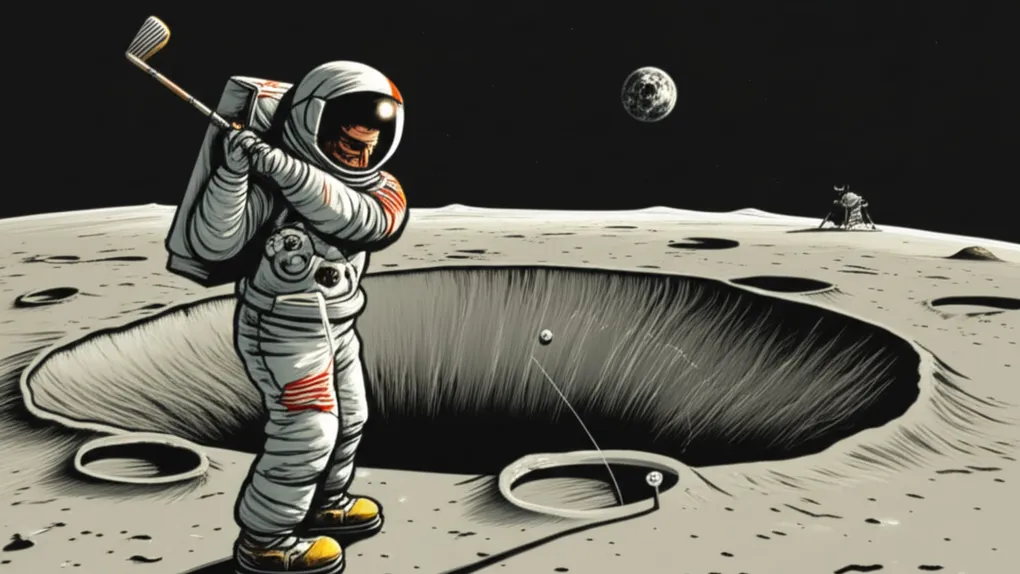
The $12 Stunt NASA Didn't Know About
I’ll admit something: I’m a terrible golfer. Not “needs a lesson” terrible. More like “nearby spectators should wear helmets” terrible. But terrible golfers have a superpower that good golfers don’t. We understand the sheer joy of making solid contact with the ball, even once. That feeling when you actually hear the “crack” instead of the “thud” is enough to carry you through eighteen holes of otherwise humbling futility.
This week’s story is about a guy who took that feeling to a place no golfer has been before. Or since. This is the kind of obscure historical moment that makes for great conversation—exactly what you’ll find in The Practical Guide.
You know how golfers are. Show them a pristine expanse of untouched terrain and they can’t help themselves. Sand trap? Gotta take a swing. Mountain resort? There’s a course for that. The moon? Well…
On February 6, 1971, while roughly 600 million people watched on grainy television sets, NASA astronaut Alan Shepard pulled off the greatest golf stunt in history—and technically committed equipment smuggling in the process. Ah, and let’s not forget the nod to golf tradition everywhere: that little white lie about one’s performance on the range.
A Conspiracy of Two
Here’s what NASA didn’t know: tucked inside Shepard’s space suit was a modified 6-iron head, custom-built by Jack Harden, the club pro at River Oaks Country Club in Houston. A few golf balls were hidden in a sock. Total value of smuggled contraband onto a mission that cost $25 billion? Maybe twelve bucks.
The only person in on the plan was mission director Bob Gilruth, and even he was reluctant. His conditions were strict: golf happens at the very end of the moonwalk, and only if every scientific objective is completed first. Shepard agreed. He wasn’t about to let a few core samples stand between him and sporting immortality.
The World’s Worst Lie
After nine hours of serious lunar science, you know, collecting rocks, deploying instruments, generally advancing human knowledge, Shepard saw his opening. He pulled out the club head and attached it to a sample collection tool, essentially creating a makeshift 6-iron that looked like something you’d find in a garage sale.
Then he addressed the camera.
“Houston,” he said, “you might recognize what I have in my hand as the handle for the contingency sample return. It just so happens to have a genuine six iron on the bottom of it. In my left hand, I have a little white pellet that’s familiar to millions of Americans.”
There was just one problem. Have you ever tried to swing a golf club while wearing a suit so bulky you can barely see your feet? Now imagine that suit is pressurized, weighs 180 pounds (on Earth, anyway), and your gloves are so thick you could probably punch through a brick wall. Oh, and you can only swing with one arm because the suit doesn’t bend that way.
Miles and Miles and Miles (Not Quite)
Shepard’s first swing was… not great. He mostly moved moon dust. His second attempt connected but shanked into a nearby crater. Back in Houston, Capsule Communicator Fred Haise couldn’t resist: “That looked like a slice to me, Al.”
But Shepard had one more ball. The third swing connected clean, and the little white pellet sailed off into the blackness.
“Miles and miles and miles,” Shepard declared as it disappeared from view.
He was exaggerating. A lot.
For fifty years, nobody knew exactly how far that ball went. The moon has no GPS, no course markers, no helpful teenager driving a cart. But in 2021, image specialist Andy Saunders finally cracked the case. Using high-resolution restoration of original Apollo footage and comparing it to satellite images from NASA’s Lunar Reconnaissance Orbiter, he pinpointed both balls.
The verdict? About 40 yards.
Forty yards. That’s roughly the length of two bowling lanes. On Earth, your average weekend hacker could match that with a sand wedge. Shepard had claimed a distance that would’ve won him any long-drive competition in history, and it turned out to be a modest pitch shot.
But here’s the thing: He did it one-handed, in a 180-pound suit, standing in lunar regolith that had never been raked, with gravity so weak that his own backswing nearly tipped him over. Under those conditions, making contact at all was an achievement.
The Congressional Inquiry
When Shepard returned to Earth, he faced questions about his lunar golf outing at a Congressional hearing. A lesser man might have been embarrassed. Instead, the first American in space offered this explanation:
“I did this since I am patriotic and concerned about the security of the nation.”
The room laughed. What else could they do?
The Balls Are Still There
Here’s the kicker: those two golf balls are still sitting exactly where they landed. No wind, no erosion, no grounds crew. In a thousand years, if humans return to the Fra Mauro highlands, Shepard’s golf balls will be waiting, untouched, in the same spot…history’s longest-surviving lost balls.
Alan Shepard died in 1998, but his golf game lives on. Somewhere between the Sea of Tranquility and the Ocean of Storms, there’s a crater with a 40-yard chip shot sitting at the bottom, hit by an astronaut who just couldn’t resist the biggest sand trap in the solar system. If you’re hungry for more stories like this—weird, human, funny details from American history—check out The Practical Guide to America.