The Time a Newspaper Convinced America the Moon Had Bat-People
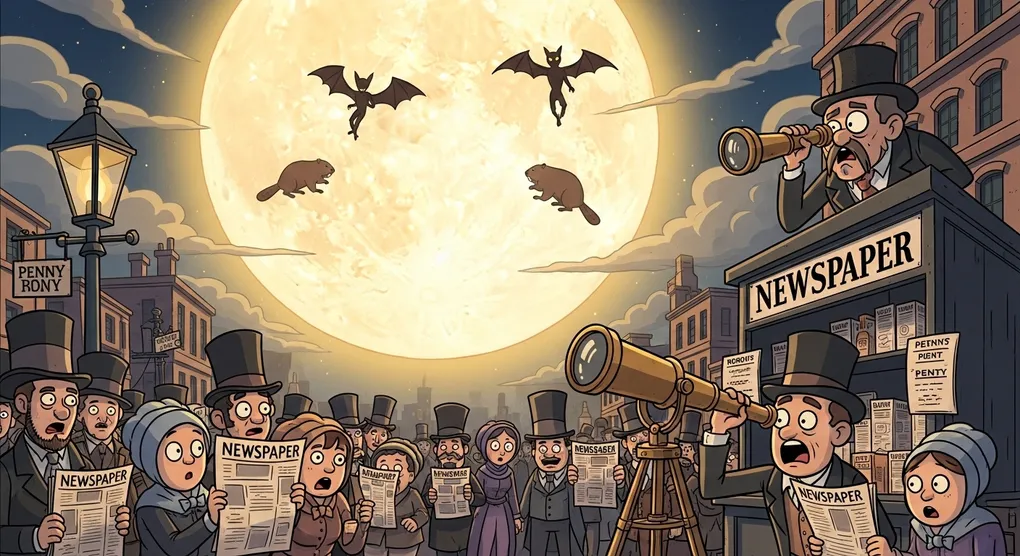
In 1835, a penny newspaper in New York convinced the entire country that the moon was crawling with bat-winged humanoids who built temples out of rubies. And people didn’t just believe it. They celebrated it.
Yes. Really.
Welcome to the Great Moon Hoax, the original fake news, and still the most spectacular one ever pulled off.
A Penny for Your Credulity
To understand how this happened, you need to understand the penny press. Before 1833, newspapers cost six cents, which was real money for a working person. They were written for merchants and politicians in prose so dry it could sand furniture.
Then Benjamin Day launched the New York Sun with a radical idea: sell the paper for one cent and make it actually interesting. Crime stories. Human interest. Gossip. The Sun was basically internet garbage before the internet. And it worked. Circulation exploded.
But Day wanted more. He needed a blockbuster. Something that would make every New Yorker line up at the newsstand before dawn.
He got one. Well, actually, he made one.
Six Days That Shook the Newsstand
On August 25, 1835, the Sun published the first installment of a six-part series claiming to reprint discoveries from the prestigious Edinburgh Journal of Science. According to the articles, Sir John Herschel, the most famous astronomer alive, had built a massive telescope at the Cape of Good Hope in South Africa. This thing was so powerful it could observe the moon’s surface in detail.
And what Herschel had supposedly found up there was, well, a lot.
The first installments started almost plausibly. Basalt rock formations. Vegetation. Forests of dark red flowers. Beaches of brilliant white sand. If they’d stopped there, it would have been mildly interesting and completely forgotten.
They did not stop there.
By installment three, the moon had bison. Herds of them, roaming lunar plains. Then came goat-like creatures with a single horn, miniature zebras, and bipedal beavers who walked upright, lived in huts, and apparently knew how to use fire. The beavers were a nice touch.
But the real showstopper arrived in installment four: Vespertilio-homo. Bat-people. Furry, winged humanoids who flew above the lunar landscape in flocks, conversed with each other through gestures, and appeared to live in a civilized society. The series described them lounging near a magnificent ruby-colored amphitheater. I could relate to living that lifestyle.
Each installment was more detailed and more outrageous than the last, written in the dense, clinical prose of a legitimate scientific report. That was the genius of it. The crazier the claims got, the more authoritative the writing sounded.
And People Bought It. All of It.
The Sun’s circulation skyrocketed. It became one of the most talked-about publications in the country practically overnight. Other newspapers reprinted the articles without bothering to check if the Edinburgh Journal of Science even existed anymore. (It didn’t. It had ceased publication two years earlier.)
The story jumped the Atlantic. European papers picked it up. Letters poured in. The scientific community scrambled to get a look at Herschel’s original observations, which of course didn’t exist.
Some unverified but widely repeated accounts from the era claim that a group of Yale scientists actually traveled to New York to track down the source material, and that a women’s missionary society began making plans to send Bibles to the bat-people. Whether or not those specific stories are true, they tell you something about the mood.
The Man Behind the Moon
The author was almost certainly Richard Adams Locke, a Cambridge-educated journalist working at the Sun. Locke never formally admitted it during his lifetime, though he later confessed to a few close associates. He officially acknowledged authorship in 1840.
Locke’s apparent motive was partly commercial, obviously, but also satirical. He was reportedly poking fun at a Scottish minister named Thomas Dick, who had published earnest calculations claiming the solar system contained over 21 trillion inhabitants. Locke figured if people would swallow that, they’d swallow anything.
He was right.
The Grudge That Launched a Second Hoax
Here’s where it gets personal. Two months before the Moon Hoax ran, Edgar Allan Poe had published “The Unparalleled Adventure of One Hans Pfaall,” a story about a man who travels to the moon in a hot air balloon. Poe had intended it as a hoax, too, a story so realistic readers would wonder if it was true.
Then Locke’s series came along and blew it out of the water. Nobody cared about Poe’s balloon story anymore. The bat-people had stolen his thunder.
Poe was furious. He accused Locke of plagiarism, which was a stretch, but rage doesn’t need to be logical. He nursed that grudge for nearly a decade. Then, in April 1844, Poe got his revenge. He published “The Balloon-Hoax” in the very same newspaper, the New York Sun, claiming that a man had crossed the Atlantic Ocean in a hot-air balloon in just three days.
It worked. The Sun printed it as fact. The public bought it for a day or two. Poe had his moment.
But we all know bat-people with ruby amphitheaters is a far better story than a guy in a balloon. Locke won the hoax wars.
The Confession Nobody Cared About
On September 16, 1835, less than a month after the series ended, the Sun essentially admitted the whole thing was fabricated. But here’s the beautiful part: it barely mattered. The paper’s readership didn’t crater. People weren’t outraged. Many readers seemed to view the whole episode as great entertainment, a spectacular show they’d gotten for a penny.
The real Sir John Herschel, meanwhile, went through stages. When he first heard about the hoax from his post in South Africa, he was reportedly amused. His real astronomical observations could never be this exciting, he joked. But the amusement curdled as years went by and people kept asking him about the bat-people. He eventually described the persistent questions as a source of real annoyance.
Can you blame him? Imagine being one of the greatest astronomers of your century, and the thing everyone wants to talk about is the bat-people you never discovered.
The Part That Should Keep You Up at Night
The Great Moon Hoax happened in a world with no internet, no television, no radio, no telephones. Information traveled by horse and ship. People had weeks to think critically before the next installment arrived. They had every opportunity to pause, reflect, and ask whether bipedal beavers with fire sounded reasonable.
They didn’t.
Now we live in a world where a lie can circle the planet before anyone finishes reading the headline. We have fact-checkers, search engines, AI detection tools, and a permanent archive of human knowledge in our pockets.
And we’re still falling for it.