The Most Outrageous American You've Never Heard Of
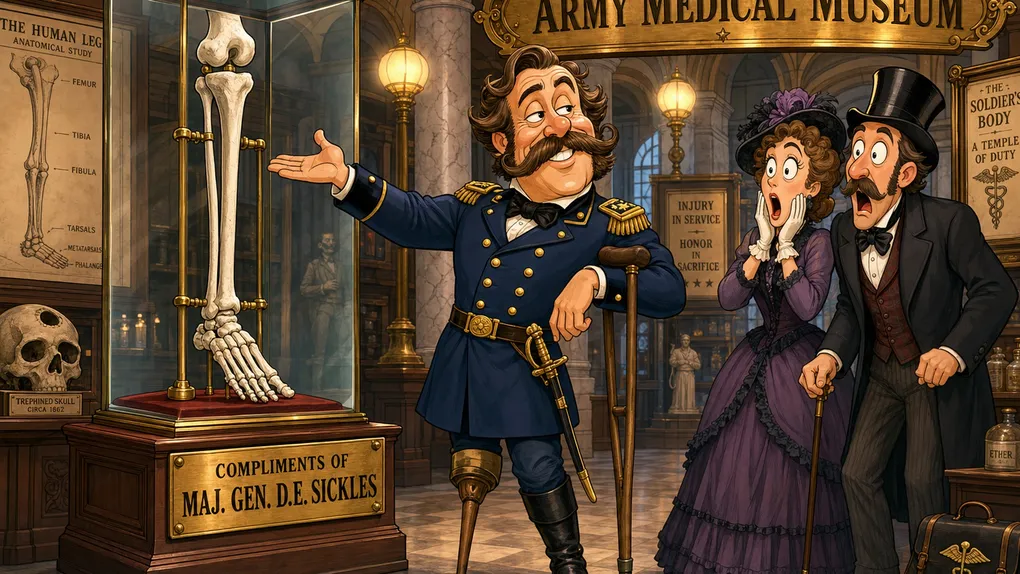
Every so often in the decades after the Civil War, an old man with a cane would walk into the Army Medical Museum in Washington, make his way to a glass display case, and stand there admiring the shattered leg bones inside. Sometimes he brought friends along, like he was showing off a vacation photo. Apparently, the museum staff knew him on sight.
They should have. It was his leg, so he’d kind of earned visitation rights.
Let me introduce you to Daniel Sickles, perhaps the most outrageous American you’ve probably never heard of.
The Congressman, the Handkerchief, and the Derringer
In February 1859, Sickles was a sitting congressman from New York, living in a townhouse on Lafayette Square, directly across the park from the White House. He was a Tammany Hall fellow with a scandal résumé that would impress ten modern politicians, including the time he (allegedly) escorted a famous prostitute onto the floor of the New York State Assembly. He’d married Teresa Bagioli when she was 15 (he was 33), then mostly ignored her while he worked the political levers of Washington.
Young and lonely Teresa found company in the arms of Philip Barton Key II, the U.S. District Attorney for D.C. You know the name. His father was Francis Scott Key. You know, the guy who wrote “The Star-Spangled Banner.” Their signal system was not exactly subtle. Key would stand in Lafayette Square and wave a white handkerchief at her bedroom window. Half of Washington knew about the affair. Included in the half that didn’t was Sickles, but eventually an anonymous letter made sure he did too.
One Sunday afternoon, February 27, 1859, Sickles looked out and saw Key in the park, his handkerchief fluttering away. He grabbed a Derringer and a revolver, ran outside, and yelled, “Key, you scoundrel, you have dishonored my house, you must die.” Then he shot him. In broad daylight, in front of dozens of witnesses, within sight of the White House. Surprised and outgunned, Key’s defense consisted of throwing his opera glasses at Sickles. It didn’t help.
It’s OK. He Was Temporarily Insane
Sickles surrendered and went to jail, where he was held in conditions appropriate to a gentleman of his standing, meaning he had visitors, a servant, and his dog living in the cell with him. His defense team, led by Edwin Stanton, Lincoln’s future Secretary of War, tried an argument that had never once succeeded in an American courtroom: temporary insanity. The shock of the affair, they claimed, had briefly driven Sickles mad, and as such, Sickles couldn’t be held legally accountable.
The jury deliberated for 70 minutes and acquitted Sickles. The courtroom cheered, a band played outside, and Sickles was carried through the streets.
Then Sickles did the one thing 1859 Washington could not forgive. He took Teresa back. Yup. The social code of the day implied that a wronged husband was practically expected to kill his wife’s lover, but forgiving the wife? Scandalous. His political career was torched, not by the murder, but by the reconciliation.
Failing Upward?
When the Civil War broke out, Sickles saw his comeback opportunity. He raised a brigade of New York volunteers, used his Tammany connections to wangle a general’s commission despite having precisely zero military experience. The street shooting doesn’t count. He turned out to be a decent, if reckless, leader. By July 1863, he was a major general leading the III Corps at Gettysburg.
On day two of the battle, General Meade ordered him to hold a section of the Union line on Cemetery Ridge. Sickles didn’t like his position, and without asking anyone, marched his entire corps a half mile forward to a peach orchard. This punched a hole in the Union line and left both his flanks exposed. When the Confederate attack came, it shredded his corps and very nearly the whole Union position with it.
Cannonball Karma
Around 6 p.m., while watching the disaster unfold, Sickles was hit by a 12-pound cannonball that mangled his right leg below the knee. He was carried off on a stretcher calmly puffing a cigar so his men wouldn’t panic. A surgeon amputated the leg that night.
Sickles being Sickles, he’d heard about the brand-new Army Medical Museum soliciting battlefield specimens (read, body parts) for research. So he had his leg packed in a box and shipped to Washington with a card that read, “With the Compliments of Major General D.E.S.” As the story goes, he even sent the cannonball. True? Sounds unlikely, but it makes the story even weirder.
The museum preserved it, mounted it in a case next to a cannonball, and put it on display. Sickles, as you know, came to visit it for the rest of his life.
Self-Generated Icing on the Cake
Sickles spent his remaining 51 years arguing to anyone within earshot that his disobedience at Gettysburg had actually saved the battle by disrupting Lee’s plan, and suggesting a Medal of Honor was in order. Historians mostly disagree. Sickles outlasted the argument, lobbying for decades until Congress handed him the Medal of Honor in 1897, at age 77, for the day he nearly lost the battle.
He also served as U.S. Minister to Spain, where he was rumored to have had an affair with the deposed Queen Isabella II. He got elected to Congress again at 73. He went bankrupt. He was investigated for embezzling from a Civil War monuments commission. He died in 1914 at age 94 and was buried at Arlington, where he asked for no monument over his grave.
I suppose he already had a monument. His leg has been on continuous public display since 1863, and is now at the National Museum of Health and Medicine in Silver Spring, Maryland, sitting beside a cannonball.