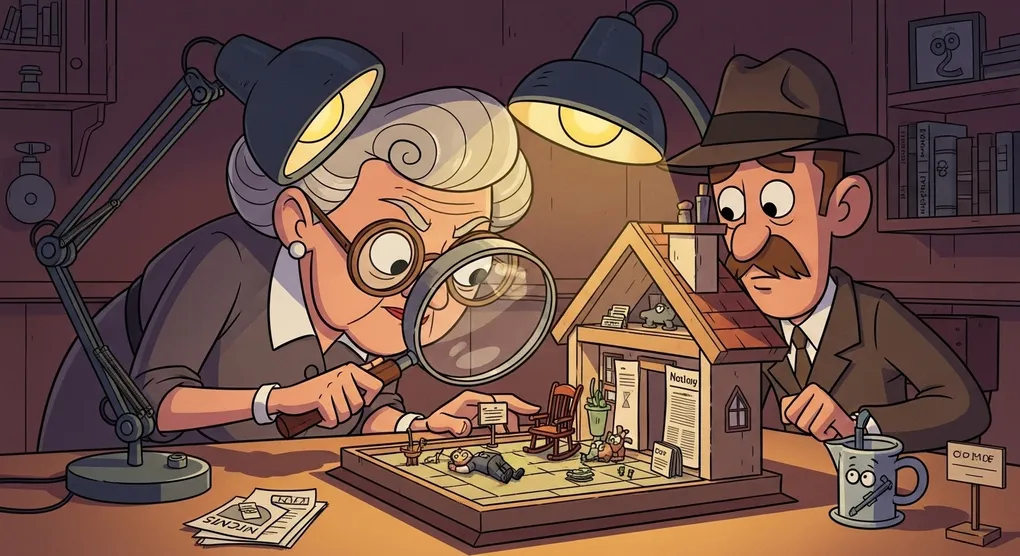
The Grandmother Who Invented CSI With Dollhouses
You know that moment in every cop show? The detective crouches over the body, squints at a coffee cup, and announces that the victim was killed somewhere else and moved here later. That whole ritual, the careful reading of a room like it’s a murder mystery written in furniture and bloodstains, exists because a Chicago grandmother in her sixties started building dollhouses. Well, sort of. It’s a great story, so grant some poetic license here.
Dateline dioramas. Complete with working light bulbs the size of a grain of rice and hand-knit wool socks she stitched using straight pins for needles.
I’m not exaggerating this for the newsletter. There are eighteen of these mini crime scene dollhouses sitting in Baltimore right now, in 2026, and real homicide detectives still spend a week studying them every single year. Her name was Frances Glessner Lee, and she is the reason you expect blood-spatter analysis on television.
The heiress who wasn’t allowed to do anything
Frances was born big-time wealthy in 1878 thanks to International Harvester money. Not “nice house and a boat” money. “Your name is on all those tractors” money. And in that world, a girl’s job was to marry well, run a household, and stay decorative.
She wanted to study medicine at Harvard. Her family said absolutely not, that’s no pursuit for a young woman of your standing, and steered her toward a respectable marriage to a lawyer instead. So she did. She married at twenty, had three kids, and ran the home. The marriage faded, as you might guess. We don’t know exactly why, but it’s easy to imagine she was bored to tears given her aptitudes and lofty ambitions. She was divorced by thirty-six, which in 1914 was its own scandal.
Then she waited. For years, she had the brains and the ambition and absolutely no permission to use either.
Then her brother died, and around the age of fifty-two, she inherited the whole fortune. For the first time in her life, Frances had money, and nobody left to tell her what a woman of her standing could and couldn’t do.
She used it to become obsessed with murder. Wouldn’t we all? Well, maybe not, but Frances was cut from a different cloth.
A dinner-party friend and a national disgrace
The obsession had a source. Years earlier, she’d befriended George Burgess Magrath, a medical examiner who used to tell her, over dinner, exactly how badly America handled dead bodies. And yes, it was bad.
Most death investigations weren’t run by doctors. They were run by coroners, who were often elected, frequently untrained, and sometimes just the local funeral director or a guy who’d won a popularity contest. Crime scenes got trampled. Bodies got moved before anyone who knew anything arrived. Evidence vanished. Murderers strolled away clean, and every so often an innocent person swung for a crime the scene itself could have cleared them of, if anyone had known how to process it like those geniuses on modern CSI shows.
Frances decided to fix this with her checkbook and her hands. She funded a department of legal medicine at Harvard, endowed a professorship for Magrath, and built the country’s finest forensic library. But she kept circling one stubborn problem. The science existed. The trouble was that cops showed up at a scene and didn’t know how to look.
So she decided to teach them. With dollhouses. Cops and dollhouses? Yep.
The Nutshells
She named them after an old detective’s creed, that the job is to “convict the guilty, clear the innocent, and find the truth in a nutshell.” The Nutshell Studies of Unexplained Death. Twenty of them, each one a composite stitched together from real cases, built at a scale of one inch to the foot.
The detail is where your jaw drops. She spent the price of a luxury car on every single diorama. Tiny working locks with keys that worked. Real tobacco rolled into cigarettes thinner than a toothpick. Letters with legible handwriting. Newspapers printed at one-twelfth scale that you could actually read. A whittled rocking chair that rocked. And the bodies, painted to the precise mottled color a corpse turns at a given hour, slumped exactly where the real victims fell.
Here’s the twist most people miss. These weren’t whodunits. Lee didn’t care if you named the killer. The Nutshells were observation tests. The whole point was to train a detective to scan a room methodically, in a slow spiral, top to bottom, missing nothing, and let the scene tell the story instead of guessing at it. Read the room, not your hunch.
Captain Lee throws a dinner party
She started running week-long seminars at Harvard, the Harvard Associates in Police Science. And to get a room full of hardened cops to take homicide lessons from a wealthy older woman, Frances did something perfect. In 1943, she got the New Hampshire State Police to commission her as a captain, which made her the first female police captain in the United States.
Then she leaned all the way into it. She hosted her seminar detectives at lavish banquets at the Ritz in Boston, full formal place settings, the works, treating them like visiting royalty. And then she sent them back to the table to stare at a corpse in a dollhouse and figure out what they’d missed.
How a dollhouse ended up on your TV
Harvard shuttered its legal medicine department in the 1960s, and the Nutshells nearly got tossed. Maryland’s Office of the Chief Medical Examiner rescued them, and the seminar still runs there every year. Detectives still get their week. Eighteen of the original twenty are still on active duty as teaching tools, which makes them some of the oldest working forensic equipment in America. In 2017, the Smithsonian’s Renwick Gallery put them on display in a show called “Murder Is Her Hobby,” and crowds lined up to see crime scenes the size of breadboxes.
But the real legacy isn’t the dioramas. It’s the chain of detectives she trained, who trained the next generation, who set the standards that became modern forensic investigation. The careful, systematic reading of a scene that every TV detective now performs as a party trick traces straight back to a grandmother and her murder dollhouses.
Lawyers even have a name for the side effect. The “CSI effect,” where juries now expect DNA, fiber, and blood-spatter analysis on every case because they’ve watched a thousand hours of it, and they get suspicious when the evidence isn’t gift-wrapped. That expectation runs back through decades of forensic training to the woman who taught America’s first generation of scientific detectives.
So the next time a TV detective announces the victim was moved, raise your glass to Frances Glessner Lee. Heiress, divorcee, captain, grandmother, and the deadliest dollhouse builder who ever lived.