The French Tried to Make America Metric. Pirates Got There First.
Ask someone why America still measures things in feet and pounds while the rest of the planet has gone metric, and you’ll get the usual answers. Stubbornness. Cost. Freedom. America just does America. All of these are a little bit true. But the most entertaining answer involves a French botanist, a copper cylinder, and a boatload of pirates.
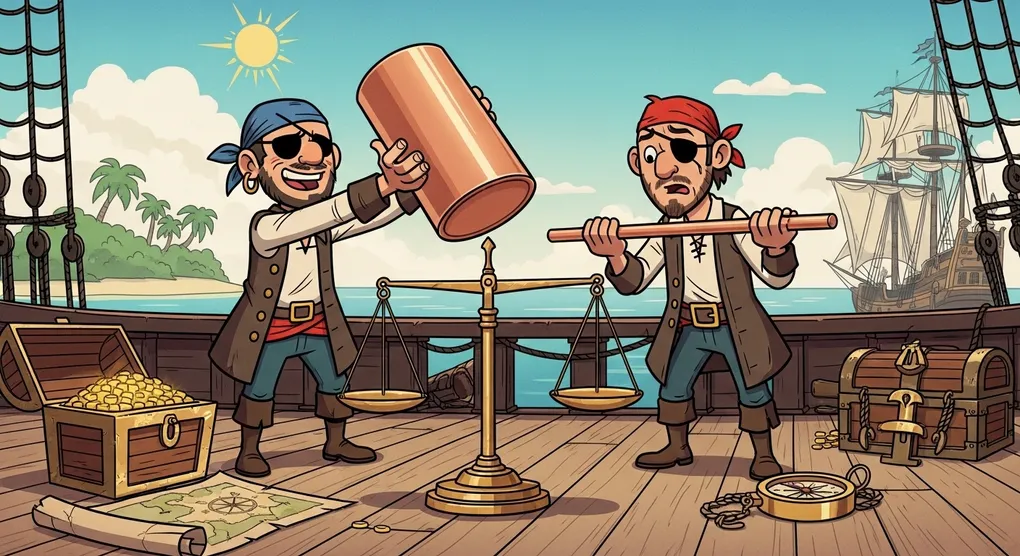
In early 1794 (yes, not a typo of ‘1974’), France put a man named Joseph Dombey on a ship in Le Havre that was headed for Philadelphia. He carried two objects France hoped would change how America measured everything: a copper rod exactly one meter long, and a copper cylinder, called a “grave,” that weighed exactly one kilogram. They’d rename it “kilogram” the next year, presumably after someone realized “grave” was a super-weird thing to call a weight standard. Waiting in Philadelphia was Thomas Jefferson, then Secretary of State and a card-carrying enthusiast for anything decimal. The plan was simple. Show Congress these arguably sensible (except the ‘grave’ name) standards, let the logic sell itself, nudge a young nation toward base ten.
Dombey never arrived.
A storm shoved his ship off course and deep into the Caribbean, where two British privateers, which is the polite term for government-licensed pirates, surrounded him. Dombey was no fool. He scrambled below deck, threw on a Spanish sailor’s clothes, and tried to pass as one of the crew. It almost worked. Then he opened his mouth, his very French accent gave him away, and the pirates hauled him to the island of Montserrat to hold for ransom. He died there before anyone paid.
This was, sadly, a bizarre recurring theme of sorts. Dombey had already lost one specimen collection to the British and another to a business dispute with Spain. The man spent his life carrying precious cargo across oceans and kept losing it. The kilogram was his last delivery, and pirates took that too.
The standards got auctioned off with the rest of the ship. Through a chain of French middlemen, they eventually reached Jefferson’s successor, Edmund Randolph, who looked at history’s most consequential paperweights and did, well, absolutely nothing. The grave then wandered into the hands of a surveyor named Andrew Ellicott, sat in his family for generations, and in 1952, a descendant donated it to the agency we now call NIST. In case you’re not familiar, NIST is the National Institute of Standards and Technology. That little copper cylinder, possibly the very one the pirates grabbed, sits in a museum in Gaithersburg, Maryland, today.
Now here’s where I have to come clean, because the headline is too good to be entirely true. Pirates make a fantastic villain, but they didn’t actually kill the idea of America going metric. Jefferson was already sold. The problem was Congress, which looked at the whole question, decided to break for lunch, provided lobbyists were picking up the tab, and sat on it for the better part of forty years. Even if Dombey had strolled into Philadelphia with his copper goodies, he’d almost certainly have hit the same wall. NIST’s own historian calls the pirate episode “a bit of a footnote to history.” You’ve gotta love the story, though.
And the real punchline is that America secretly went metric anyway. Since 1893, the customary definitions of the inch and the pound have been defined by meters and kilograms. It did take many more years for the government to certify the details, however. Every inch on your tape measure is now legally defined as exactly 2.54 centimeters. We’ve been a metric country in disguise for over a century.
So no, pirates didn’t sink the metric system. But they did drown the messenger, steal the kilogram, and hand us one of the best “what if” stories in American history.
See you next week.