The Deadliest Theater Review in American History
Here’s a sentence that sounds made up: in 1849, New York City had a riot over Shakespeare, and the army shot at least 22 people dead.
Not a metaphor. Not a heated debate that “turned ugly.” Actual paving stones, actual muskets, actual bodies in the street outside a theater. All because two actors couldn’t agree on the right way to play Macbeth.
It’s absurd on its face. Then you find out it was never really about Shakespeare at all, so maybe it makes more sense? No, not really.
Two Guys, One Play
The feud was between Edwin Forrest and William Charles Macready. Forrest was American, muscular, and loud, the kind of actor who played to the cheap seats and got worshipped for it. Macready was English, refined, and cerebral, beloved by people who used “summer” as a verb.
They’d been friendly once. That ended in 1846, when Forrest sat in a private box in Edinburgh watching Macready perform Hamlet. Macready did a little flourish with his handkerchief, a fancy bit of stage business, and Forrest, who thought it was ridiculous, hissed him. Out loud.
Then he doubled down by admitting it in print and defending it. The newspapers on both sides of the Atlantic loved the controversy. On the far side of the pond, perhaps they pronounced it “con-trah-ver-sy?” A grudge between two vain men became a transatlantic celebrity war, and the public picked sides like it was a Super Bowl.
The Powder Keg
Here’s the part the “crazy fact” version leaves out. By 1849, the Forrest-versus-Macready thing had stopped being about acting. It became America versus England. Working class versus elite. The Bowery versus the boardroom.
It didn’t help that Macready was booked at the Astor Place Opera House, a venue so snooty it reportedly enforced a dress code: kid gloves, white vests, clean-shaven faces. To a New York laborer, that wasn’t a theater. It was an insult. You know, the Yank version of hearing something like, “Let them eat cake.”
So when both men happened to be performing Macbeth in the same city in the same week, the teakettle was ready to boil over.
The Mistake
Forrest’s fans bought tickets to Macready’s May 7 show and pelted the stage with rotten eggs, potatoes, old shoes, and actual chairs until he stopped. Humiliated, Macready announced he was done and sailing home.
Then a group of wealthy New Yorkers, 47 of them, including Washington Irving and Herman Melville, signed a letter begging him to perform one more time on May 10. He said yes. That was the mistake.
In the days before, handbills flooded the city asking, “Shall Americans or English rule in this city?” The pitch was aimed straight at the Bowery toughs and Irish immigrants still raw from the Famine, and it hit close to home.
Curtain Call
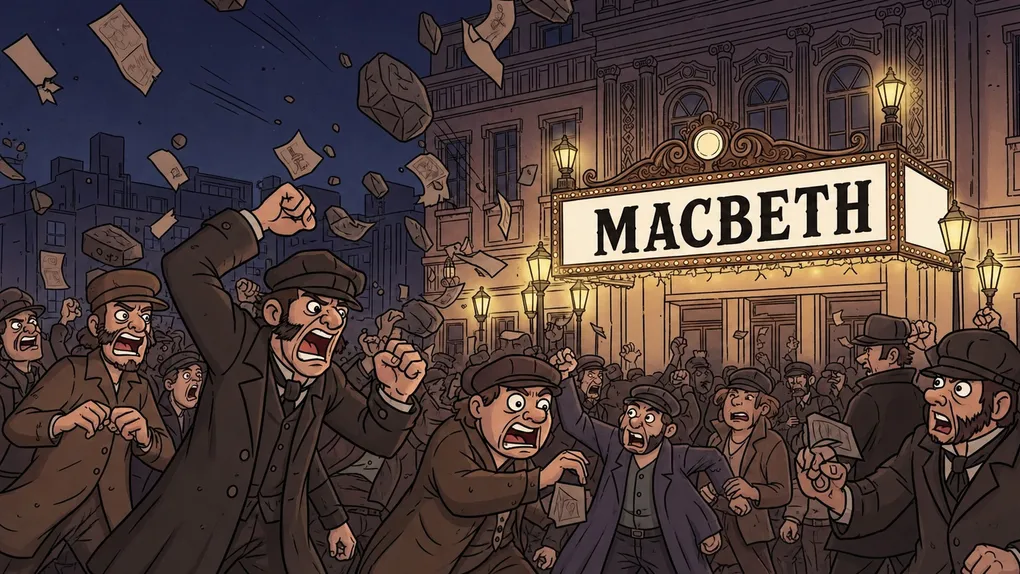
On the night of the 10th, Macready performed inside under police guard while a crowd of 10,000 or more gathered outside, throwing paving stones, smashing windows, and trying to storm the doors. The police couldn’t hold them.
So the state militia, pre-positioned nearby because somebody saw this coming, opened fire. The first volley went over the mob’s heads. When that didn’t work, an officer ordered them to fire straight into the crowd at close range.
At least 22 people died. More than 100 were hurt. Many of the dead were bystanders who’d come to watch the spectacle, not throw rocks. It remains the deadliest case of American troops firing on American civilians since the Revolution.
Macready slipped out in disguise and never performed in America again.
So the next time someone calls theater people dramatic, you can tell them about the night New York proved it, and how the army handled the curtain call.