The Civil War Started in His Front Yard. He Moved 120 Miles. It Ended in His Living Room
In my book, The Practical Guide to America, I told the story of how the first major battle of the Civil War was a spectator event. People packed lunches, brought chairs, and expected to watch an entertaining afternoon unfold. How they assumed a large-scale battle would be anything short of horrifying remains a mystery.
It didn’t take long for the spectators to flee in abject terror.
Not all of the spectators were there by choice. One man ended up with front-row seats to both the beginning and the end of this country’s most costly military conflict.
Most of us get a bit stressed when a tree branch blows down and lands on the house or car. Then I learned about Wilmer McLean.
Wilmer redefined bad luck with the real estate priority list: location, location, and location. His front yard hosted the start of the Civil War, and his living room hosted the end. Same guy. Two houses. One war. Now, hold on to your hat.
The Sugar Trader Who Lived Next to the Wrong Creek
In the summer of 1861, Wilmer McLean was 47 years old, comfortably middle-aged, and running a successful wholesale sugar business out of Yorkshire plantation. Yorkshire sat in northern Virginia, near a small railroad junction called Manassas, right beside an unremarkable stream named Bull Run.
You can probably see where this is going.
On July 21, 1861, the first major engagement of the Civil War, known as Bull Run in the North and Manassas in the South, was fought across his property. Confederate General P.G.T. Beauregard had already taken over McLean’s house as his field headquarters. McLean, being a helpful neighbor type, even gave the general some tactical advice on local geography. Then the shooting started.
At some point in the chaos, a Union artillery shell came down the kitchen chimney and exploded in the fireplace. According to McLean’s own telling, it ruined a stew that was cooking for the Confederate officers’ supper. Historians have argued for 160 years about whether the shell came down the chimney or just hit the kitchen, but everyone agrees the dinner was pretty much a loss.
Then, in August 1862, the armies came back and did it all over again. The Second Battle of Bull Run. Same neighborhood, same farm, same nightmare. McLean had seen enough.
The Quiet Place
In late 1862, McLean sold Yorkshire and went looking for a place where absolutely nothing was happening. Like Possum Kingdom, South Carolina, but closer to his old home. He found Appomattox Court House, a tiny crossroads village of about 150 people in central Virginia. It had a courthouse, a tavern, a couple of stores, and a stagecoach road that the railroads had passed by years earlier. Nothing of military value. Perfect.
He bought the biggest house in town, a handsome two-story brick place, and moved his family 120 miles south. Out of the war’s path. Out of the way. Problem solved.
You and I both know that’s not how this story ends.
Twenty-One Months Later
By April 1865, the war was finally collapsing. Robert E. Lee’s Army of Northern Virginia, exhausted and starving, was retreating west from Richmond with Ulysses S. Grant chasing them. Lee got cornered just outside Appomattox Court House and sent word that he was prepared to surrender.
A Confederate officer named Charles Marshall rode into town to find a suitable building for the meeting. The first man he ran into on the street was Wilmer McLean. McLean tried to direct him to a half-derelict, empty building down the road. Marshall took one look and said, “No, this won’t do. Find me a real house.”
McLean, likely with the resigned look of a man who has been here before, offered up his parlor.
That afternoon, in his living room, Lee and Grant sat down at two small tables. Grant came in mud-spattered from the field. Lee wore his dress uniform with a ceremonial sword. They made small talk about the Mexican-American War, then they got down to it. The terms were generous. Confederate soldiers got paroled, kept their horses, and went home unprosecuted. Grant signed first. Lee signed second. The Civil War was pretty much over.
What’s a Story Without Some Looting?
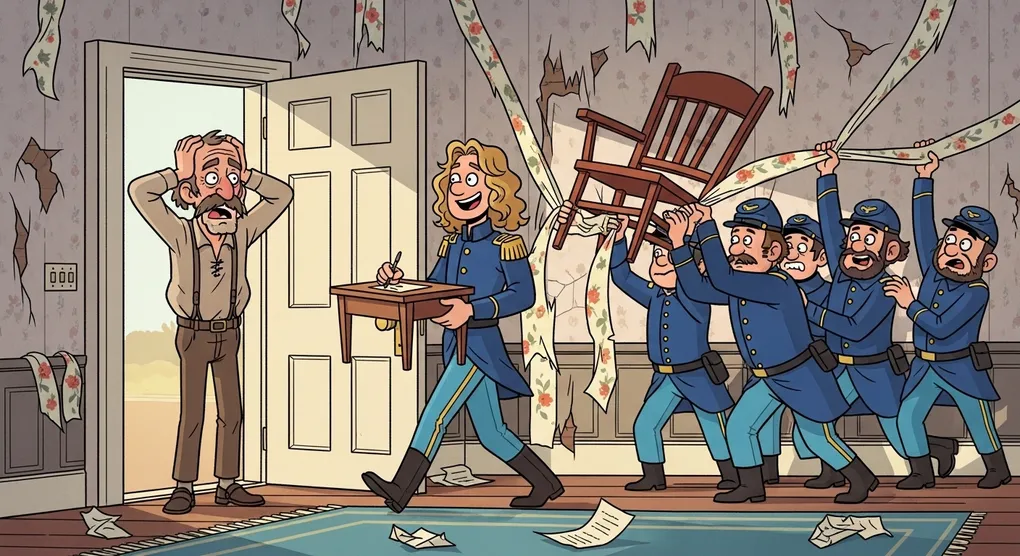
The minute the document was signed, Union officers descended on the parlor like it was a yard sale at a celebrity’s house. They wanted relics.
General George Armstrong Custer, the cavalry showman, paid 20 dollars in gold (or didn’t, depending on whose account you trust) for the small wooden table at which Lee had signed, and rode off with it tied to his horse. General Edward Ord paid 40 dollars for Grant’s table. Brigadier General Henry Capehart got Lee’s chair. Major General Philip Sheridan paid in gold for another table and gifted it to Custer’s wife as a souvenir. Other officers cut the chairs apart for the upholstery. Wallpaper got peeled off the walls in strips and stuffed into pockets.
McLean tried to refuse at first. He got pushed. By nightfall, his parlor was effectively empty, and his pockets were full of greenbacks, gold coins, and IOUs from men he was never going to see again.
Lee’s signing table is now in the Smithsonian. Grant’s is at the Chicago Historical Society. The wallpaper is scattered across collections.
The Punchline Nobody Knew Was Coming
McLean’s story has one more twist. After the war, he couldn’t keep up with the mortgage on the Appomattox house. The bank foreclosed in 1869. His family moved back to Alexandria, and Wilmer took a job as a clerk for the U.S. Bureau of Internal Revenue, the agency that would eventually become the IRS. Yes, the man whose house got looted by the United States Army went to work collecting taxes for the United States government.
He died broke in 1882.
The Appomattox house itself was dismantled in 1893 by speculators who thought they could put it on a traveling tour. They couldn’t. The pieces sat in a field rotting for half a century until the National Park Service rebuilt them from the originals in 1949. You can walk through that parlor today. The furniture has been replaced with replicas. The originals are elsewhere, behind glass.
He’s reported to have said, in some version or another, that the war began in his front yard and ended in his front parlor.