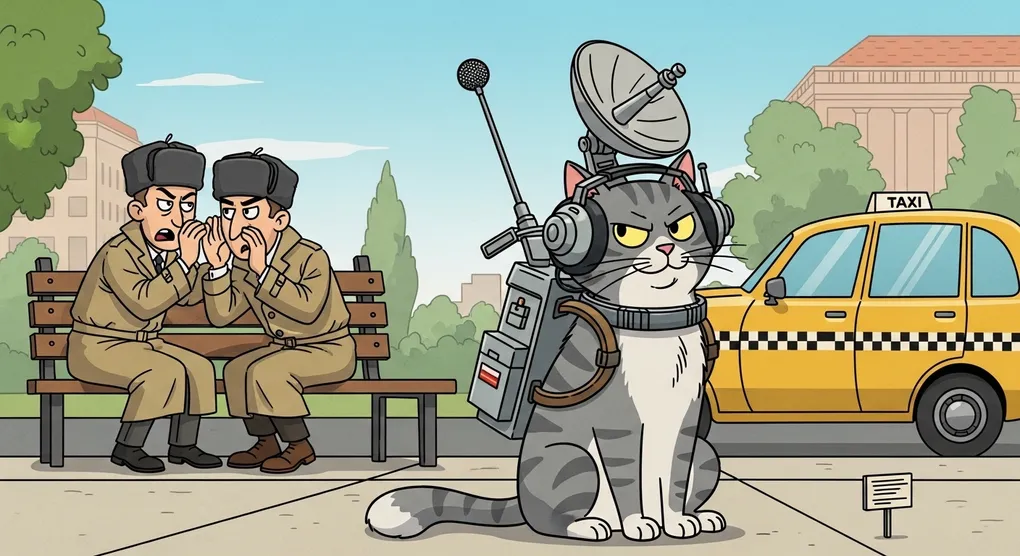
The CIA spent $20 million turning a cat into a spy
I once spent twenty minutes trying to coax a neighbor’s cat off the hood of my car. The cat looked at me the way cats look at all of us, like I was a mildly interesting change in the weather, and did not budge. So I feel a strange kinship with the men I’m about to tell you about, because in the 1960s the Central Intelligence Agency spent five years and around twenty million dollars learning the exact lesson I learned about cats.
The lesson is this: a cat does what a cat wants.
Here’s what the smartest people in American intelligence somehow did not know going in. It was the height of the Cold War. Soviet diplomats were careful to talk near a bugged phone or a wired-up hotel room, and the CIA was desperate for a way to listen in. Somewhere inside the Directorate of Science and Technology, the division in charge of the agency’s strangest hardware ideas, a group of engineers, biologists and a veterinary surgeon looked at the problem and arrived at the answer. A cat. Not a cat as a metaphor. An actual cat.
The thinking, believe it or not, kind of made sense. Cities are full of cats. Nobody notices them. A cat sitting near an embassy doesn’t set off alarms or pique the interest of the spies and anti-spies lurking about. In the language of spycraft, a cat is invisible.
So they got themselves a grey-and-white tabby, put it under anesthesia, and the surgeon went to work. He slid a tiny microphone into the cat’s ear canal. He buried a small radio transmitter at the base of its skull. He threaded a thin wire antenna through the length of the animal’s fur, all the way down to the tail, so the tail itself became the antenna. He tucked batteries into the chest cavity, stitched the whole thing back up, and woke it up. By all accounts, the cat was annoyed but weirdly functional. They called it Acoustic Kitty.
Then they hit the first snag. Cats get hungry. And when a cat gets hungry, it wanders off to find food, spy mission or no spy mission. You cannot run a surveillance operation on an agent who abandons his post to go chase a pigeon. So back into surgery the cat went, this time to suppress its hunger drive. Read that again. America’s premier intelligence agency performed a second operation to teach a cat not to be a cat. Admittedly, I’m more of a dog person, but I’m starting to feel pretty bad for the cat at this point, national security or not.
Five years of training followed. Handlers worked to get the cat to walk where they pointed, sit near a target, and hold steady in a noisy park. They had, let’s say, limited success. The training notes suggest real progress on short trips and zero progress on the underlying problem: a cat really doesn’t give a hoot what humans want it to do.
Victor Marchetti, a former CIA officer who later wrote a book that did not flatter his old employer, described the finished product to a reporter in five unforgettable words. “They made a monstrosity.” That quote is now part of the permanent record, because the agency declassified the whole program in 2001 after the National Security Archive at George Washington University filed a Freedom of Information Act request.
In 1967, they decided Acoustic Kitty was ready. A team drove a van to a park in Washington, D.C., directly across from the Soviet compound on Wisconsin Avenue. Two men sat talking on a bench. The van door slid open. They set the cat on the sidewalk, gave the signal, and pointed it toward the targets.
The cat walked into the street and was promptly flattened by a passing taxi. Twenty million dollars and five years of research, undone by a Yellow Cab that had no idea it was ending a federal surveillance program.
In later years, a former official named Robert Wallace insisted the taxi story was a joke that got taken too seriously, and that the cat actually survived, had its hardware removed, and retired in peace. Marchetti and others swore the cab was real. The declassified memos don’t settle it. They simply note the program was canceled in 1967. So the record is permanently split between “the cat got hit by a taxi” and “the cat was fine, and the project was just bad.” Either way, it ended.
And the cancellation memo is a humorous attempt at justifying a crazy program. It calls training a cat to move short distances “a remarkable scientific achievement,” then concludes that the technique “would not be practical for our highly specialized needs.” Translation: cats are cats, and we are not going to fix that with surgery.
Acoustic Kitty was not even the weird project that year. The same division was, at the same time, trying to build a remote-controlled raven, designing a poison-tipped umbrella, and cooking up a chemical to make Fidel Castro’s beard fall out. By Cold War standards, the spy cat was a perfectly normal idea.
See you next week.