America's First and Only Emperor
When all else fails, and desperation becomes your middle name, what do you do? It’s time for some phoenix-level life situation resurrection. It’s possible, just ask Joshua Norton. Well, back when he was alive, of course. For Mr. Norton, the answer was obvious. Declare yourself Emperor of the United States and see what happens. What do you have to lose? Maybe someone will notice. San Francisco noticed. Then San Francisco played along. For twenty-one years.
The Worst Rice Bet in American History
Norton arrived in San Francisco in 1849 with $40,000 in his pocket, which back then was enough to buy a small town. By 1853, he’d parlayed that into a quarter-million-dollar real estate fortune. Then he heard a rumor that China was about to ban rice exports. He saw an opening, mortgaged everything, and tried to corner the Peruvian rice market. A boatload of Peruvian rice arrived a week later. Then another. Then several more. The price collapsed. So did Norton’s fortunes. He spent the next five years in court, lost everything, and withdrew from public life. Most people would have crawled into a bottle. Norton had a different plan.
”Norton I, Emperor of these United States”
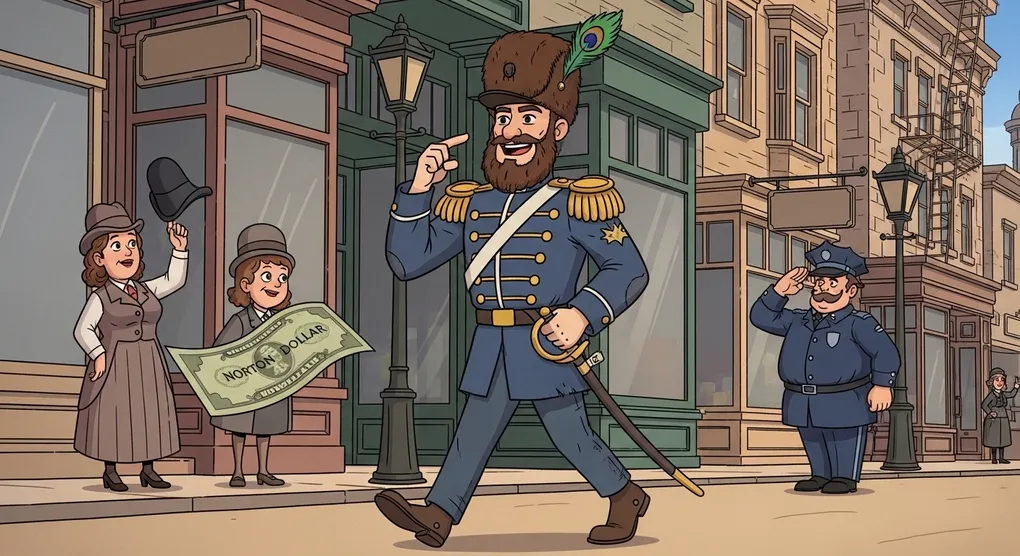
On September 17, 1859, Norton walked into the offices of the San Francisco Bulletin carrying a single piece of paper. The editor, most likely somewhat amused and very possibly hungover, ran it on the front page. Norton declared himself Emperor of the United States. A few years later, after the French invaded Mexico, he tacked on “Protector of Mexico,” because, well, why not? Then a strange thing happened. The city, instead of laughing him out of town, embraced its new emperorship. Army officers at the Presidio donated a blue military uniform with gold epaulettes. Norton wore it everywhere, paired with a beaver hat sporting a peacock feather and a saber on his belt. Restaurants seated him for free. Theaters reserved the best box for him at every premiere. Local merchants accepted “Norton dollars” he’d printed himself. Those bills are now collector’s items, selling for thousands. I took a quick look on eBay and did manage to spot some “Norton stamps.” I suppose the currency is hard to come by. He governed by decree. He dissolved both the Republican and Democratic parties. Can we all agree that was a brilliant and benevolent move? He banned the word “Frisco” under threat of a $25 fine. He demanded a suspension bridge connecting San Francisco and Oakland through Yerba Buena Island. That last one took about 64 years to build. We call it the Bay Bridge. Hey, the man had jumbo aspirations.
The Day the City Defended Its Emperor
In 1867, a rookie cop named Armand Barbier arrested Norton, hoping to commit him to an asylum. He didn’t make it through the booking. The outcry was immediate and ferocious. Newspapers ran outraged editorials. Citizens flooded the police station. Police Chief Patrick Crowley released Norton within hours and issued a public, written apology. Norton, always magnanimous, “pardoned” the officer. After that, every cop in San Francisco saluted him on sight.
”Le Roi est Mort”
On January 8, 1880, Norton collapsed on a San Francisco street and died before help arrived. The next morning, the San Francisco Chronicle ran the front-page headline in French: Le Roi est Mort. The King is Dead. Somewhere between 10,000 and 30,000 people lined the streets for his funeral. The procession was two miles long. A man with no army, no taxes, no actual throne, and not a dollar to his name got the goodbye of a head of state. Norton didn’t conquer anything. He didn’t get rich. He just put on the uniform and acted as if he belonged in it, and an entire city decided, “Why not?”