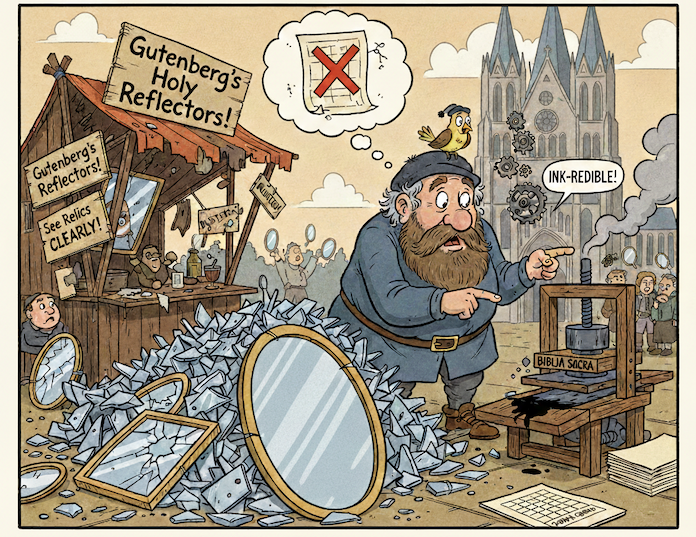
Picture 1430s Germany. People saved up for years to make a pilgrimage to Aachen Cathedral, which houses some seriously impressive holy relics, including the swaddling clothes baby Jesus wore, the Virgin Mary's dress, and the cloth used to mop up after Herodias’ daughter Salome asked for John the Baptist’s head on a platter.
Every seven years, the cathedral would display these sacred artifacts, and pilgrims would swarm in by the tens of thousands.
Every good business begins with the solution to a problem. This one was that with so many people crammed into one cathedral, most pilgrims couldn't actually *see* the relics through the massive crowds.
Enter the entrepreneurs.
Gutenberg's Gizmo
Local craftsmen figured out a solution: small, concave metal mirrors that pilgrims could hold up to "capture" the holy emanations radiating from the relics. Couldn't get close enough to see Jesus's baby blanket? No worries. Just angle your mirror correctly, and you'd catch those divine vibes through the mirror.
Theologically sound? Most would say, “Not so much…” but the Church wasn't exactly cracking down on it, so the mirrors sold like crazy.
Johannes Gutenberg, a goldsmith living in Strasbourg, saw an opportunity. He formed a business consortium around 1438 with a few partners, including a guy named Andreas Dritzehn. Their plan? Mass-produce these pilgrim mirrors and cash in on the 1439 Aachen pilgrimage.
They went to work on industrial-scale production, planning to produce up to 100,000 mirrors. The mirrors were cast from a specific alloy of lead, tin, and antimony.
So far, everything was going according to plan.
And then the plague showed up.
So Much for the Business Plan
The 1439 Aachen pilgrimage? Postponed and pushed to 1440 because nobody wants to catch the Black Death while trying to absorb holy rays from a saint's decapitation towel.
Gutenberg and his partners were stuck with a warehouse full of mirrors and no pilgrims to sell them to for at least another year. The investment was spent.
Then things got worse. Andreas Dritzehn died (maybe from the plague, given the timing, but we really don’t know), and his brothers sued Gutenberg, demanding either their brother's investment back or a spot in the partnership.
The resulting lawsuit, preserved in Strasbourg court records from 1439, is actually how we know any of this happened. And buried in those legal documents is a tantalizing detail that people have puzzled over for centuries.
The Mysterious "Four Pieces"
When Dritzehn died, Gutenberg urgently sent people to the workshop with specific instructions: take apart "the four pieces" so that no one would "perceive its function." Then, during the trial, witnesses mentioned that Gutenberg had some kind of secret project going on outside of the mirror business.
Many believe the mystery gear was an early version of a type mold. If true, this would have been the innovation that enabled movable type printing. A type mold enabled identical metal letters to be cast quickly and precisely, a breakthrough that would have made the printing press practical.
To add a bit of weight to the theory, those pilgrim mirrors Gutenberg had been cranking out were made from the same metal alloy (lead, tin, and antimony) that he'd later use to cast movable type.
The Ultimate Pivot
So let's recap: A goldsmith tries to get rich selling religious souvenir mirrors. Plague ruins the timing. His partner dies. He gets sued. He's broke.
And somewhere in the wreckage of that failed venture, tinkering with metal alloys and precision casting techniques, Johannes Gutenberg figures out how to mass-produce books.
Within fifteen years, he'd print 180 copies of the Gutenberg Bible. Before, each copy would have taken a monk years to copy by hand. Within a generation, printing presses spread across Europe. Within a century, the Protestant Reformation, the Scientific Revolution, and the spread of literacy were reshaping civilization.
The Lesson (If There Is One)
Silicon Valley types love to mythologize failure as a stepping stone to success. Usually, it's just spin. But every once in a while, a catastrophic business failure really does force someone to discover something bigger. YouTube ended up doing just fine after its pivot, as did Twitter (X), Instagram and numerous others.
Gutenberg didn't set out to democratize knowledge or launch the information age.
His invention was Plan B.