What do the following have in common? Art, meaning paintings in this case. An unforgiving workplace. The 50s. A single mom working to feed her family. MTV.
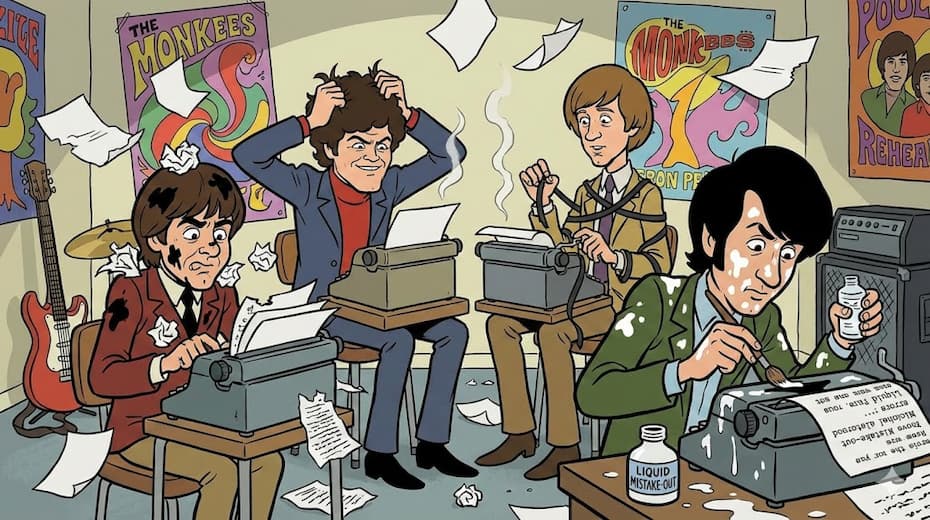
Give up? I’ll give you a hint. It also involves that made-for-TV band, The Monkees, but also impatient bosses in 1950s corporate America.
There’s one more factor that makes this a classic American “can-do” story: the spirit of entrepreneurship. Just ask Bette Nesmith Graham. She’s the common thread running between all these things.
Working 9 to 5
Navigating the working world as a single parent is never a cakewalk, and it was even less so for a divorcee with a young son in back in the 1950s. Bette worked in Texas as a typist in the stereotypical corporate environment.
Sympathy for the challenges of her daily life, managing a career, home and children? Not much. Tolerance for less than perfect performance at work? Also lacking.
While we take computers and word processing for granted today (Wordstar, the first popular general-purpose word processing software, came out in 1978), correcting mistakes made on a typewriter (remember those?) was a bit of an adventure. Almost always, the correction process was more like a complete redo. Rip out the offending page and start over from the top. And, as you might guess, the boss didn’t much care that you were up late with a sick kid and making more mistakes than usual. Frequent typing corrections (starting over) meant letters and proposals weren’t going out as fast as they should.
Art Meets Business
But Bette Nesmith Graham wasn’t limited to the typical typing pool mindset. She also had a bit of interest in painting. And painters handle mistakes differently.
Ever seen Picasso or Jackson Pollock whip out an eraser to “remove” a mistake? Well, no. Then again, none of us have seen them actually paint, but if we had, we’d almost certainly see them handling mistakes in a much different fashion. Rather than trying to physically “remove” the “oops,” they’d just paint right over it and keep on going.
Thinking like an artist, Bette got to wondering… “I wonder if, rather than throwing away all my work and starting over, I could ‘paint’ over my typing mistakes and just keep on going?”
Kitchen-Preneurship
Lots of multinational corporations started in garages. Apple is a great example. But lots of other businesses have started inside the home, often right in the kitchen. Think Amazon and Google. Yeah, really.
And so did Bette.
At home, in her kitchen, she mixed a white, water-based paint that matched the color of her company’s stationery. She poured it into a small bottle, lifted one of her son’s small paintbrushes and brought it to work, anxious to test it on the next “oops.”
Soon enough, she had made her mistake and applied the “typing paint” with her tiny brush. When it dried, she typed right over the error. And guess who noticed the error? No one. Well, except the other secretaries. Word of the mistake saving magic paint spread through the office like wildfire.
Soon, Bette was making batches of her typing fix-it blend, and when it spread to other businesses, she started to sell the paint and gave it a real name—Mistake Out.
When a Side Hustle Becomes the Main Event
By 1956, Bette’s kitchen business was growing too fast to remain a part-time venture, and here is where the story gets a bit fuzzy. Some accounts say she was fired for spending too much time and energy on her side hustle. Others indicate she resigned from her typist job voluntarily to focus on the business.
Whatever the reason, she renamed the product Liquid Paper, and the business was off to the races.
Her son, Michael, helped fill bottles and pack orders. Nothing teaches business fundamentals like sticky fingers and shipping deadlines.
Not surprisingly, Bette grew her company with a healthy dose of employee-friendly culture. Today, it’s not so unusual, but in the 1960s, her focus on things like benefits and a family-friendly environment was outside the norm.
A Rocky Road to Success
Like many business trajectories from the kitchen table to boardrooms and factories, this one was not paved with rose petals. Years after marrying her second husband, Bette had to fight to keep control of the company, which by the mid-1970s was producing some 25 million bottles of Liquid Paper per year worldwide. She did, and in 1979, sold the business to Gillette for some $48 million. Not a bad venture for a hard-working typist.
Hey, Hey It’s the Monkees!
Young Michael Nesmith did not follow his mother’s career path into office supplies.
Instead, he became part of one of the strangest cultural experiments of the 1960s: The Monkees. Yep, that made-for-TV band with its own built-in sitcom side gig. While fun to joke about now, the entirely produced rock group was successful by most any measure, cranking out millions of records and earning a sizable TV audience. And that idea of pairing music with acted scenarios on film would serve Michael quite well later on down the road.
In the late 1970s, Nesmith became fascinated with the idea of extending the ways music and visuals could be paired. He created a television program called PopClips, which aired in 1980-1981. The Nickelodeon show should sound familiar now: a series of music videos as the primary content, curated and hosted by a “veejay.” In 1981, the show was sold to Warner-Amex, which in turn launched the MTV network. Nesmith had no official role in MTV. His role was more one of proof of concept and inspiration.
So there it is. Did a hard-working and seriously stressed-out secretary unknowingly set the stage for the music video revolution, all while saving the sanity of millions of secretaries worldwide?