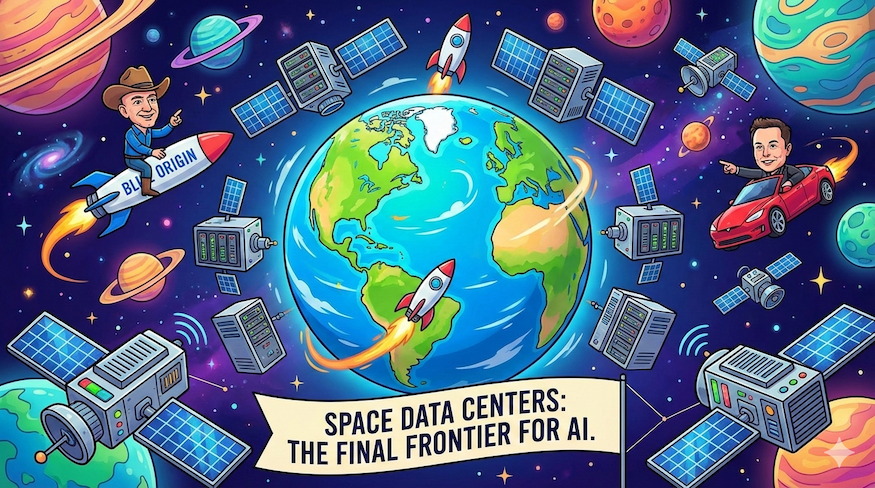
The phrase *“data centers in space”* sounds like something cooked up during a late-night ganja-fueled sci-fi binge. And yet, it’s real. Very real. At first glance, this seems outrageously expensive. Rockets are not known for their budget-friendly pricing. So why would anyone even consider it?
Because Earth, it turns out, is becoming a surprisingly inconvenient place to run the machines that now answer all of our utterly ridiculous questions.
Buildings in Space?
No one has launched a full-scale AI data center into orbit yet, but several players are circling the idea with intent. Microsoft has partnered with companies to test lunar data storage. The European Space Agency is studying orbital data centers powered by solar energy. Jeff Bezos’s Blue Origin has floated space-based infrastructure concepts as part of its long-term vision. Even startups are getting involved, pitching modular “server satellites” that could be assembled in orbit.
These aren’t warehouse-sized buildings floating through space, at least not at first. The near-term vision is smaller, modular units: hardened servers designed for vacuum, radiation, and extreme temperature swings. The plan is to make them kinda like Legos that can be assembled in orbit. Maybe they’re hiring 12-year-old Legomaniacs?
It’s Not (Quite) as Crazy as It Sounds
Believe it or not, saving money is the driving factor behind all this.
Modern AI data centers consume staggering amounts of electricity, and that is upsetting municipalities across the country who are already struggling to provide enough power for summer AC and winter heat. A single large facility can draw hundreds of megawatts which is roughly the output of a small power plant. Collectively, data centers already consume around 1–2% of global electricity, and AI is pushing that number upward fast. Just in the US last year, computers used up 4% of the total power output and that number is expected to double in just a few years.
Even something trivial, like asking an AI whether your dog might enjoy a Brown Sugar & Cinnamon Pop-Tart, requires computation across massive neural networks. Estimates vary, but a single AI question can use anywhere from 0.002 to 0.01 kilowatt-hours of electricity. That’s roughly the same as running an incandescent (the ones you can’t find anymore) light bulb for about five minutes. That sounds tiny until you multiply it by billions of daily AI conversations worldwide.
In space, sunlight is abundant, constant, and free once you’re there. No clouds and if you plan your orbits right, no night downtime for solar power. No angry zoning boards protesting a new substation. Solar arrays in orbit can generate power 24/7, sidestepping one of Earth’s biggest bottlenecks. And the best part? Solar power panels in space are eight times more efficient than down here on Earth.
AI data centers generate immense heat, and most are cooled using water. Lots of it. Recent studies estimate that training a large AI model can consume hundreds of thousands of gallons of fresh water. Even routine operations, the everyday answering of mundane questions, adds up fast. In 2024, US data centers used 17 billion gallons of water to keep computers cool.
One analysis suggested that 20–50 AI questions could indirectly “consume” about half a liter of water, depending on the cooling system and energy source. So yes, making dinner reservations through an AI assistant has a small but real freshwater footprint.
Space is very good at heat removal. Thermal radiation works better in a vacuum, and no water is required. Heat can simply be radiated away into the cosmic void. As they say, it’s cold in space.
But Isn’t Launching Computer Farms Insanely Expensive?
Yes. At least today and in the short-term future.
Launching payloads into orbit still costs thousands of dollars for sending just a couple of pounds of cargo. But that number is dropping fast. Reusable rockets, mass production, and competition are pushing launch costs downward in the same way computing costs fell over the last 40 years.
Once infrastructure is in place, space data centers could have lower long-term operating costs: no land purchases, no water rights battles, no local energy shortages, no neighbors complaining about transformer hum at 3 a.m.
The economics don’t work *yet* but they’re headed in the feasible direction.
Fun Facts to Take With You
- A single, large data center can use as much electricity as 80,000 homes.
- The Sun delivers more energy to Earth in one hour than humanity uses in a year. Solar panels in space allow more of that to be put to use.
- The Moon has no atmosphere, no water, and extreme temperatures. That’s not a bad environment for things that are averse to corrosion.
Data centers in space? Maybe not so crazy after all.