When Your Bones Glow in the Dark, Something's Wrong
Imagine this: It’s 1922. You’re a young woman, maybe 18 or 19, and you just landed a great starting job. The pay is good, the work is clean, and you’re indoors. The job is painting tiny numbers on watch dials with a special luminous paint. Your friends are jealous. You’re gainfully employed and on your own.
Your supervisor shows you the technique on day one: dip the brush in the paint, put it in your mouth to shape the tip, then paint. Lip, dip, paint. Lip, dip, paint. You do this about 250 times a shift.
There’s one small fly in the ointment: the paint is radioactive.
The Glow-in-the-Dark Dream Job
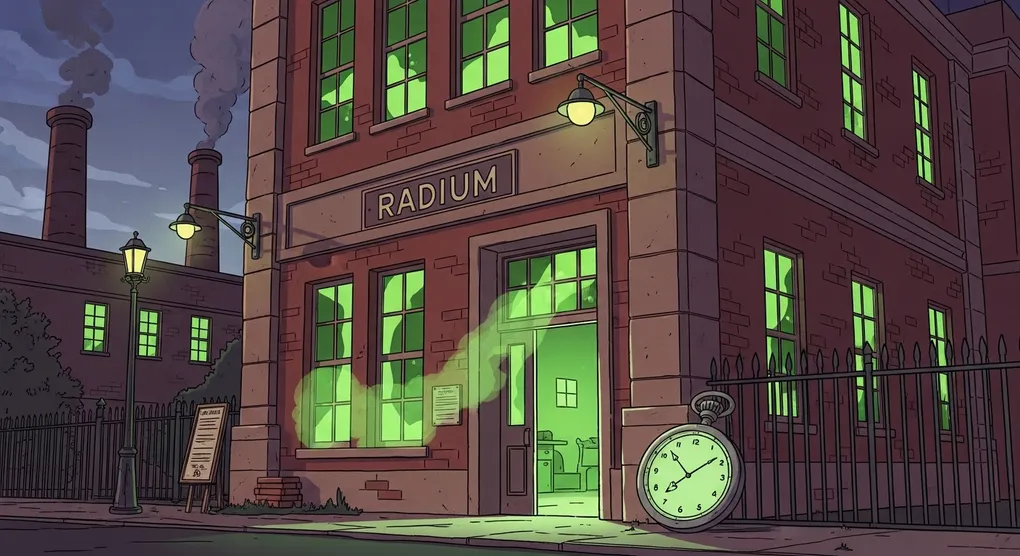
The U.S. Radium Corporation factory in Orange, New Jersey, was a hot place to work, and I mean that in the “everyone wants a job there” sense, not the “you’re being slowly irradiated” sense, though both turned out later to be true.
The dial painters were mostly young women in their teens and twenties. They earned about a penny and a half per dial, which doesn’t sound like much until you realize the fast ones could knock out 250 dials a shift, pulling in around $24 a week in 1920s money. For context, that was serious cash for a young woman, especially one without a college degree. In today’s terms, think about $500 a week.
The paint itself was a mixture of radium, zinc sulfide, gum arabic, and water. It glowed a beautiful, ghostly green. The women loved it. They painted their nails with it before dates. They dabbed it on their teeth so their smiles would glow in the dark. They dusted it in their hair for dances. They called themselves the “Ghost Girls.”
Management told them the paint was perfectly safe. One supervisor even claimed it would put roses in their cheeks.
America’s Radioactive Love Affair
To be fair to the women, literally everyone thought radium was magic in the 1920s. This wasn’t just ignorance on their part. It was more like a national craze.
You could buy radium toothpaste. Radium chocolate bars. Radium-infused wool blankets for babies. Radium suppositories. Yes, really. There were radium condoms, radium boot polish, radium hair cream, and a wildly popular “energy drink” called Radithor, which was just distilled water spiked with radium.
A socialite golfer named Eben Byers drank three bottles of Radithor a day because he was convinced it was a miracle health tonic. He did this for three years. By the end, his teeth had fallen out, his jaw had to be surgically removed, and holes had formed in his skull and brain. When he died in 1932, The Wall Street Journal ran a headline that’s hard to beat for dark humor: “The Radium Water Worked Fine Until His Jaw Came Off.”
The dial painters weren’t uniquely naive. They were surrounded by a culture that thought radiation was basically a vitamin.
Things Start Falling Apart
By the mid-1920s, something was clearly wrong with the dial painters.
It started with their teeth. A woman would go to the dentist for a toothache, and the dentist would pull the tooth, which sounds normal enough, except the jawbone would come with it. Entire chunks of jaw just crumbled and came away. Dentists had never seen anything like it.
Then came the fractures. Bones that broke from almost nothing, a stumble, lifting a bag, rolling over in bed. The women developed terrible anemia. Tumors. Joints that locked up or collapsed.
Here’s the haunting detail: because the radium had been incorporated into their bones, replacing calcium in the same way it replaces calcium in everything (radium is chemically similar enough to calcium that your body can’t tell the difference), the women’s skeletons had become radioactive. Their bones literally glowed.
Some of them noticed. In a dark room, you could see the faint luminescence coming from inside their own bodies.
The Cover-Up That Makes Your Blood Boil
This is where the story goes from tragic to infuriating.
The U.S. Radium Corporation knew. A company scientist named Sabin von Sochocky, who had actually invented the luminous paint, seems to have warned them, but the facts are a bit shaky on the nature of his warning. Nevertheless, he himself was getting sick from radium exposure. The company ignored him. He later died of aplastic anemia in 1928.
When workers started getting sick, the company hired a doctor from Columbia University to examine them. His name was Frederick Flynn. He declared them healthy. What the women didn’t know was that Flynn wasn’t actually a doctor. He was a toxicologist on the company’s payroll, and his “examination” was a sham designed to produce a clean bill of health.
It gets worse. When a real doctor, Cecil Drinker from Harvard, conducted an independent study and found alarming levels of radioactivity in the workers, the company submitted his report to the New Jersey Department of Labor with the results altered to make everything look fine.
And when dial painters started dying? The company persuaded doctors and dentists to list the cause of death as syphilis. Not just to deflect blame, but to destroy the women’s reputations so their families would be too ashamed to ask questions.
Five Women and a Lawyer Nobody Else Would Be
In 1927, a former dial painter named Grace Fryer decided to sue. She was 28. Her spine was collapsing. She knew she was dying.
It took her two years to find a single attorney willing to take the case against U.S. Radium Corporation. Lawyer after lawyer turned her down, either afraid of the powerful company or unconvinced that a case against them could be won. Finally, a young Newark attorney named Raymond Berry said yes.
Grace was joined by four other women: Quinta McDonald, Albina Larice, Edna Hussman, and Katherine Schaub. The press called them “the Five Women Doomed to Die.”
The trial was a national sensation. Reporters from The New York World and the Chicago Tribune photographed the visibly dying women as they testified. A physicist named Elizabeth Hughes measured the radioactivity in their breath and testified that all five women were so saturated with radium that their exhalations were toxic.
The company settled in the autumn of 1928. Each woman received $10,000 and a $600-per-year annuity, plus medical and legal expenses. Adjusted for inflation, the $10,000 is roughly $180,000 today.
The Woman Who Testified From a Stretcher
But the New Jersey case was only half the story.
In Ottawa, Illinois, a different company called Radium Dial was pulling the exact same playbook. Same lip-pointing technique. Same lies about safety. Same sick and dying workers.
A dial painter named Catherine Wolfe Donohue had started feeling ill in 1925. By 1931, her limping was so bad that Radium Dial fired her, not because they felt guilty, but because, in Catherine’s own words, “my limping was causing much talk.”
Catherine and her coworkers sued. By the time she testified before the Illinois Industrial Commission in 1938, she was so sick she had to be carried in on a stretcher. She gave her testimony lying down, barely able to speak above a whisper.
The Ottawa women won their case.
Catherine Donohue died on July 27, 1938, the day after Radium Dial’s attorneys filed their next appeal.
What They Left Behind
The Radium Girls’ lawsuits didn’t just win them settlements. Their cases established the legal precedent that companies are responsible for the health of their employees. The cases and publicity shaped the development of workplace safety standards across the country, and helped end the legal concept that workers “assumed the risk” of whatever horror show their employers cooked up.
One last bit, as if you’re not shocked enough as it is. Radium has a half-life of 1,600 years. When one of the dial painters was exhumed years after her death, the inside of her coffin glowed with the soft luminescence of radium compounds. Every bone, every piece of tissue, still radioactive. In fact, some of the women had to be buried in lead-lined coffins.