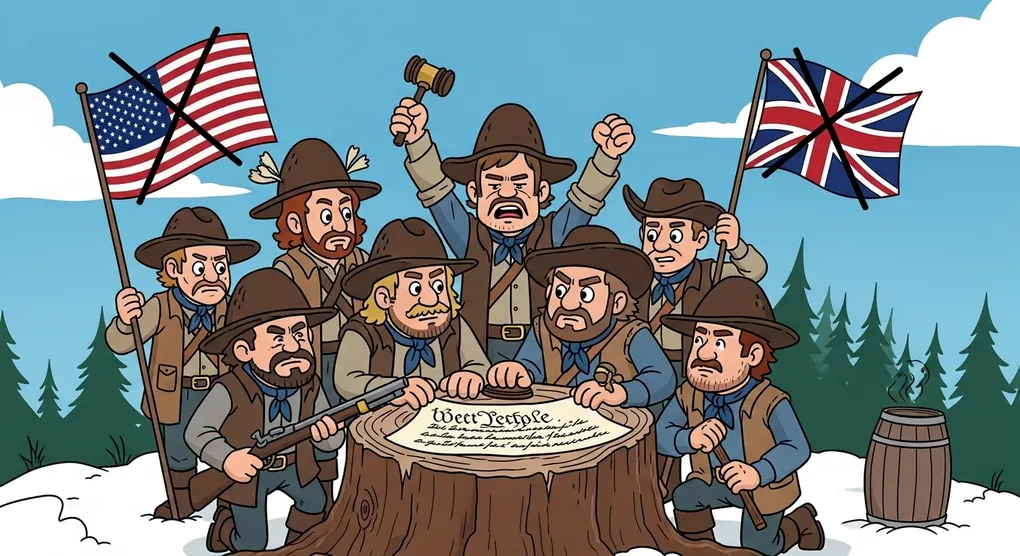
The Tiny Republic That Seceded from America AND Canada
In 1832, about 300 people living in north-north (that’s kind of like north-east or north-west, but means really, really north) New Hampshire looked at the United States, looked at British Canada, and said, “You know what? We’re good. Let’s be our own country.” Then, unlike most complainers, they actually did it. They wrote a constitution, elected a government, raised a militia, and ran a sovereign republic for three years. It took an armed invasion to end the whole thing. Welcome to the Republic of Indian Stream. Yeah, it was temporary, but they outlasted the longevity of the Crimean People’s Republic back in 1917. That only lasted a few months.
The Treaty That Couldn’t Draw a Straight Line
This affair traces back to the 1783 Treaty of Paris, which ended the Revolutionary War. The treaty defined part of the US-Canada border as running along the “northwesternmost head of the Connecticut River.” It sounds specific enough, right? Except three different streams all claim to be the headwaters. Pick one and you get America. Pick another, and you get Canada. Pick the third, and you get a strip of wilderness where nobody can agree who owns the place. For about fifty years, that ambiguity was mostly a shrug. The area was remote, heavily forested, and populated by a few hundred subsistence farmers who just wanted to be left alone. But by the early 1830s, both governments figured out these people existed, and both started demanding taxes. Typical governments. Canadian authorities wanted duties. New Hampshire wanted property taxes. The same 300 families were getting squeezed by two countries, neither of which could prove it actually owned the place.
”Fine, We’ll Be Our Own Country”
On July 9, 1832, the residents did what any reasonable group of overtaxed frontier farmers would do. They declared independence from everybody. The constitution they drafted wasn’t some scribbled note on birch bark, either. It had a bill of rights, a five-person governing council, an elected assembly, and a functioning court system. They even raised a 41-man militia, which meant roughly one out of every seven citizens was armed and on call. Per capita, that’s a better ratio than most actual countries. For three years, the Republic of Indian Stream governed itself. They settled disputes, collected their own taxes, and told both the US and British Canada to pound sand and snow, respectively.
A Hardware Store Debt Ruins Everything
Sounds great, right? So you already know it couldn’t last. In 1835, a British sheriff crossed into Indian Stream territory to arrest a resident over an unpaid debt at a hardware store. The Streamers didn’t take kindly to foreign law enforcement. They shot the deputy and sabered the magistrate. New Hampshire suddenly decided it cared very much about this particular stretch of wilderness and sent the militia to occupy the territory. The republic was done. A 41-guy militia doesn’t get very far against an actual state. The border question dragged on another seven years until the Webster-Ashburton Treaty of 1842 finally drew the line and handed the land to the United States.
Still There
The republic is gone, but the place isn’t. It’s Pittsburg, New Hampshire, now, population about 800. At 282 square miles, it’s the biggest town in the state by area. There’s a historical marker where America’s most successful, if short-lived, breakaway republic once stood. Three hundred farmers who got tired of being taxed by two countries built their own, and made it work until somebody got shot over a hardware store bill. You have to admit, the whole thing sounds very American, so it seems logical that the Republic of Indian Stream ended up here.