The Time the Pentagon Let Pigeons Fly a Missile
Here’s a sentence I never thought I’d type: during World War II, the United States government paid one of the most famous psychologists in history to strap pigeons into the nose cone of a bomb and let them steer it into enemy ships. It’s exactly the kind of weird-but-true story that’ll make you the least boring person in the room.
And it worked.
I know. Stay with me.
A Psychologist Walks Into the Pentagon…
The year is 1943, and B.F. Skinner, the guy your Psych 101 professor wouldn’t shut up about, is trying to solve a wartime problem. Electronic missile guidance systems are expensive and unreliable. Remember, we’re talking 1943, when a “computer” was the size of a warehouse and could barely add up a weekly payroll. Skinner, being Skinner, looks at this situation and thinks, “You know what’s cheap, reliable, and surprisingly good at pattern recognition? Pigeons.”
So he walks into a meeting with the National Defense Research Committee and pitches what might be the most beautifully insane idea in military history: Project Pigeon.
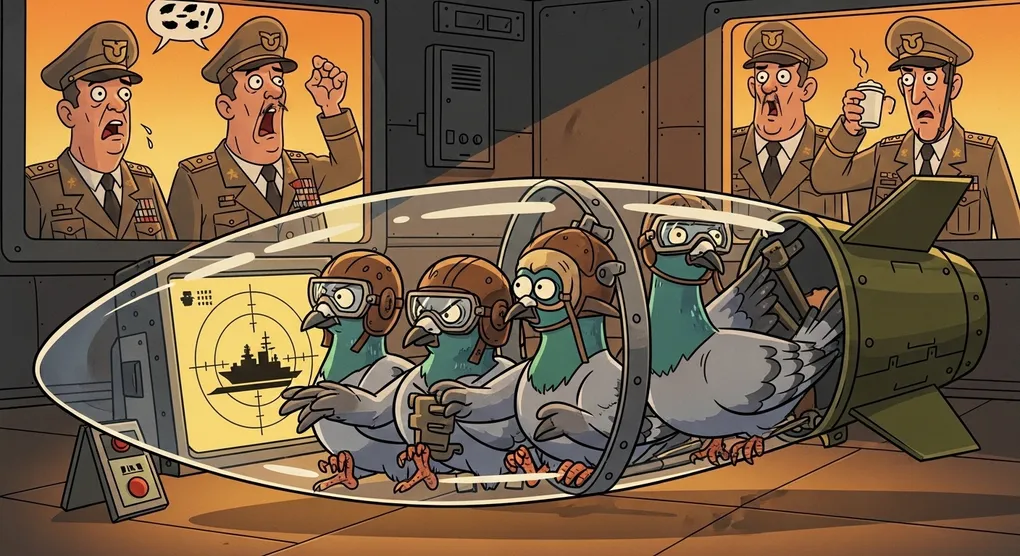
The concept was, well, awesome if you can get past the absurdity. Take a glide bomb. Put a lens in the nose cone that projects an image of the target onto a little screen. Stuff three trained pigeons inside. The pigeons peck at the target image on the screen. If the bomb drifts off course, the image moves, the pigeons follow it with their beaks, and sensors translate that pecking into steering corrections.
That’s right. Pigeons steering a bomb with their faces.
Wait, It Gets Better
Skinner didn’t just throw any random birds into a missile. He used operant conditioning, basically rewarding pigeons with food every time they pecked the right spot, to train them to recognize the silhouettes of enemy ships. These birds got good. In testing, one pigeon pecked more than 10,000 times in 45 minutes to keep the crosshairs locked on target. That’s a peck every quarter-second. For 45 straight minutes. Try tapping your phone screen that fast and see how long you last.
But here’s the really crazy detail: Skinner built in a democratic voting system among the pigeons. Three birds sat inside that nose cone, each watching their own screen. If two pigeons agreed on the target and the third dissented? Majority rules. The minority bird got overruled.
Skinner actually wrote, and I’m not making this up, that the dissenting pigeon would be “punished for his minority opinion.” Democracy in action, folks. Inside a bomb. Operated by birds.
The System That Worked Too Well
Here’s the twist that makes this story go from funny to fascinating: it worked. The pigeon guidance system was remarkably accurate in testing. The birds locked onto targets with shocking consistency. Well, maybe not shocking to Skinner, but certainly to everyone else. Skinner demonstrated the whole thing to military officials; the pigeons performed flawlessly, and everyone in the room was impressed.
And then they killed the project.
Not because the pigeons couldn’t do the job. Not because the technology was flawed. But because, and this is a direct quote from Skinner himself, “Our problem was no one would take us seriously.” Big surprise there.
Imagine being a general in 1944. You’re in a room full of decorated military brass. Someone asks about the latest guidance system for the new bomb. And you have to stand up and say, with your whole chest, “Well, sir, we’ve got three pigeons in the nose cone, and they vote on which direction to steer.”
Project Pigeon was officially canceled on October 8, 1944. The military chose dignity over accuracy. The pigeons rejoiced.
The Sequel Nobody Asked For
The Navy quietly revived the program in 1948, renaming it “Project Orcon”, short for “organic control,” which is a much fancier way to say “pigeons are flying the missile.” They tinkered with it for five more years before finally pulling the plug in 1953, when electronic guidance systems had caught up to what the pigeons had been doing all along.
So to recap: birds were ahead of cutting-edge military technology by roughly a decade. Let that marinate.
The Legacy
You might think a story this ridiculous would be forgotten, buried in some dusty Pentagon filing cabinet. But no. The actual nose cone prototype, the one with the little pigeon compartments, sits in the Smithsonian’s National Museum of American History. Right there in Washington, D.C., between the serious artifacts of American ingenuity, there’s a missile nose cone designed to be operated by birds. It’s one of countless weird-but-true moments that make American history endlessly fascinating—the kind of thing you’ll learn in The Practical Guide to America.
And in 2024, the scientific community gave Skinner the recognition he truly deserved: the Ig Nobel Peace Prize, awarded posthumously for his work on Project Pigeon. His daughter, Julie Vargas, accepted the award and thanked the committee for “finally acknowledging his most important contribution.”
The Ig Nobel Prize, for those unfamiliar, honors research that “makes people laugh, then think.” Which is the perfect description of strapping three pigeons into a bomb and letting them vote on where it goes.
The next time someone tells you an idea is too crazy to work, just remember: the pigeons nailed it. The Pentagon blinked.