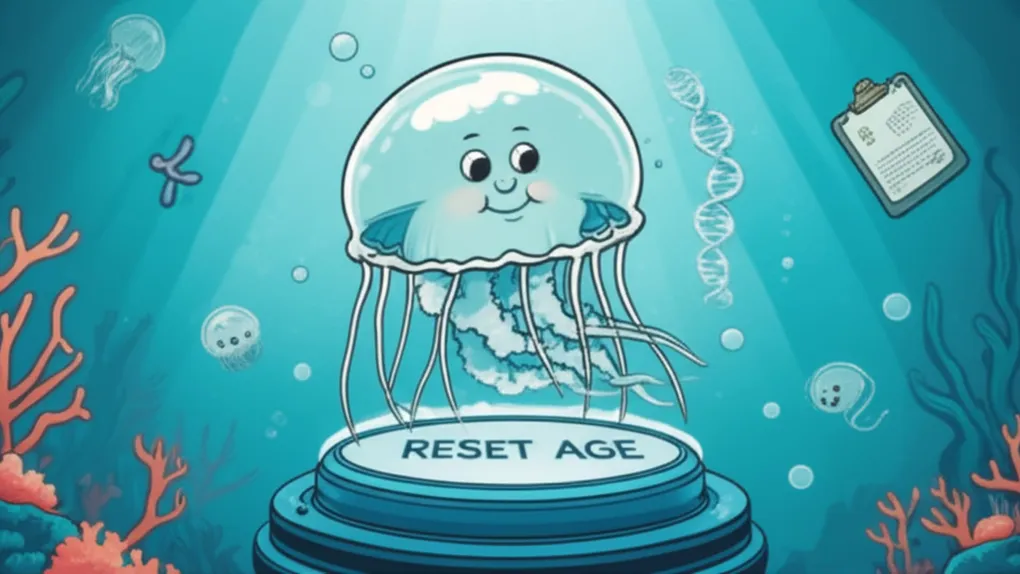
The Immortal Jellyfish That Cheats Death by Aging Backward
I’m still recovering from the worst foodborne illness of my life. 10 days in from some contagion ending in “illus” or maybe “coccus.” Or maybe I’ve managed to tick off the Kremlin, and the guy in charge dosed me with polonium. Who knows?
Whatever the case, the incident got me thinking about health, aging, and mortality. As it turns out, our feeble bodies are nothing compared to a jellyfish.
You know how every skin cream, supplement, and wellness guru promises to “reverse the signs of aging”? Turns out, nature already solved that problem. The solution is about the size of your pinky fingernail, has no brain, and lives in the ocean.
Meet Turritopsis dohrnii, the immortal jellyfish. When it gets old, injured, or sick, it doesn’t die. It just… becomes a baby again. Then it grows up. Then, if things go sideways, it becomes a baby again. Repeat forever.
It’s like Benjamin Button, except real, and without the Brad Pitt cheekbones.
The Smallest Creature with the Biggest Cheat Code
Let’s get the basics out of the way. This thing is tiny. We’re talking 4.5 millimeters across when fully grown, roughly the diameter of a pencil eraser. It’s translucent, bell-shaped, and has between eight and ninety tentacles depending on how old it is at the moment. Which, as we’re about to discuss, is a moving target.
Most jellyfish follow a pretty standard life plan. They start as larvae, settle down as polyps (think tiny stalks anchored to a rock), then bloom into the free-swimming, tentacled medusae we all picture when someone says “jellyfish.” After that, they reproduce and die. Circle of life. Elton John. You know the drill.
Turritopsis dohrnii looked at that system and said, “No thanks.”
The Biological Magic Trick
Here’s where it gets wild. When this jellyfish faces serious stress, whether that’s starvation, physical injury, disease, or plain old age, it doesn’t just tough it out. It sinks to the ocean floor, reabsorbs its own tentacles, and shrinks into a blob-like cyst. Over the next day or two, that blob reorganizes itself into a polyp. A baby. Back to square one.
Then it grows up all over again. Same jellyfish, fresh start.
The process behind this is called transdifferentiation, and it’s the part that makes biologists lose their minds. Normally, once a cell specializes, that’s it. A muscle cell is a muscle cell. A nerve cell is a nerve cell. They’ve committed. In T. dohrnii, those rules don’t apply. Specialized adult cells can transform directly into completely different types of specialized cells. No intermediate step, no going back to some generic stem cell first. Just straight-up identity swaps.
Imagine if your accountant could wake up one morning as a neurosurgeon. Not after years of medical school. Just… Tuesday.
The Nobel Prize Connection
If that cell-reprogramming trick sounds vaguely familiar, there’s a reason. In 2012, Shinya Yamanaka won the Nobel Prize in Medicine for discovering that you could reprogram adult mouse cells back into an embryonic-like state by introducing four specific genes, now called Yamanaka factors. It was a massive breakthrough for regenerative medicine.
Scientists studying the immortal jellyfish have found that T. dohrnii carries its own versions of some of those same gene families. The jellyfish appears to manipulate similar genetic networks during its reboot, including genes related to DNA repair, telomere maintenance, and stem cell renewal. It’s not a perfect match to the Yamanaka process, but the overlap has researchers very excited about what this tiny blob might teach us about human aging and cellular regeneration.
One lab even compared the genome of T. dohrnii to a closely related jellyfish that can’t pull off the immortality trick. The immortal version had extra copies of genes associated with DNA repair and variants that seem to protect its telomeres, the little caps on chromosomes that typically shorten as cells age.
In other words, this jellyfish didn’t just stumble into immortality. It’s genetically equipped for it.
The Catch (Because There’s Always a Catch)
Before you get too jealous, here’s the reality check. “Biologically immortal” doesn’t mean “invincible.” Most T. dohrnii never get to use their reset button because they get eaten first. Fish, sea turtles, and other jellyfish don’t care about your cellular reprogramming abilities. Disease takes out plenty more. The immortality trick only works if you survive long enough to deploy it.
It’s like having a parachute that works perfectly every time but only if nobody steals it before you jump.
The Silent Invasion
Here’s one more twist. This jellyfish isn’t just biologically remarkable, it’s also a world traveler. Originally discovered in the Mediterranean in the 1880s, T. dohrnii has since been found in the Atlantic, Pacific, and Indian Oceans. Researchers believe it’s hitching rides in the ballast water of cargo ships, the water pumped in and out of vessels for stability.
When scientist Maria Pia Miglietta compared DNA samples from immortal jellyfish collected off the coasts of Spain, Italy, Japan, Florida, and Panama, the genes were identical. That’s not ocean currents at work. That’s global shipping.
She called it “a worldwide silent invasion.” And honestly, when your species can just restart itself whenever conditions get rough, you’re pretty much the perfect invasive organism. Long voyage in a dark ballast tank? Stressful, sure. Fatal? Not for this jellyfish. Just reboot and carry on.
Why You Should Care
Scientists aren’t studying T. dohrnii just because it’s cool (though it absolutely is). Understanding how this creature reprograms its own cells could unlock new approaches to treating cancer, degenerative diseases, and the aging process itself. If we can figure out how a brainless, pinky-nail-sized jellyfish resets its biological clock, the implications for human medicine are enormous.
For now, the immortal jellyfish keeps quietly doing its thing, drifting through the world’s oceans, dying of nothing, and making the entire anti-aging industry look like amateurs.