Why Does the "Good Salt" Taste Better? (A Story of Blood, Goiters, and Cyanide)
The other night, I’m seasoning some Omaha Steaks I got as a Christmas gift, and I catch myself doing the thing I always do. I reach right past the fat canister of regular table salt and go straight for the kosher stuff.
And then I stopped and thought… why do I do that?
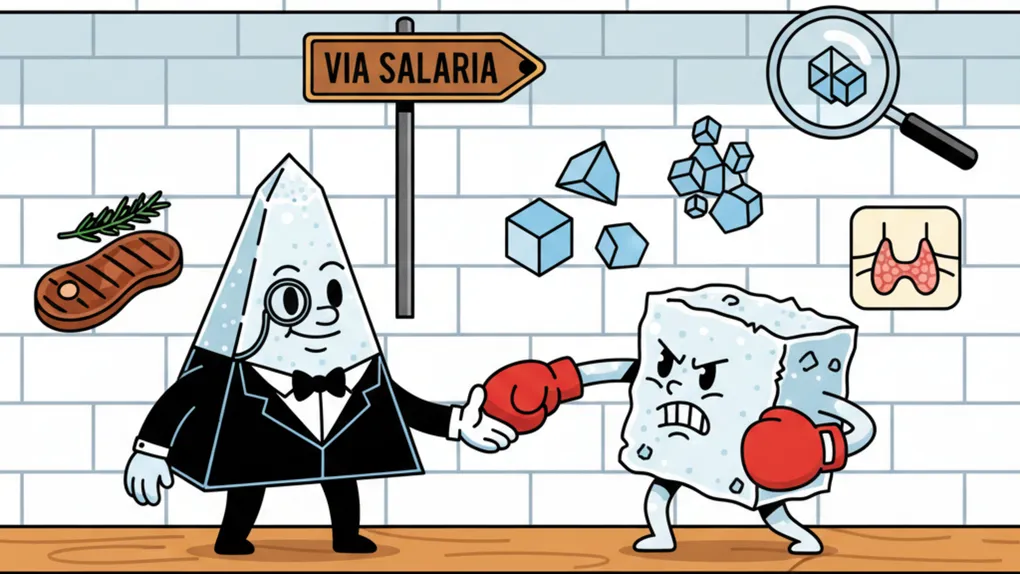
Because here’s the thing: kosher salt just tastes better. It’s gentler. Rounder. If regular salt punches you in the mouth, kosher salt gives you a nice handshake. I realize Gordon Ramsay probably wouldn’t describe it like I do, as having “fewer sharp edges,” but that’s what it feels like. Table salt is harsh and aggressive. Kosher salt is… civilized.
So I went down the rabbit hole. And what I found is that the story of salt is absolutely crazy. I had no idea…
You’re Literally Tasting the Shape
Here’s the wild part: when I say kosher salt has “fewer sharp edges,” I’m accidentally being scientifically accurate. And I had no idea.
Table salt crystals are tiny, dense cubes. Like microscopic dice. They’re hard little geometric boxes that take their sweet time dissolving. When they finally do dissolve, they deliver all their saltiness in one concentrated blast. You know, like biting into a bouillon cube. Yes, I used to do that as a kid. Don’t judge; you did weird stuff too.
Kosher salt is a completely different animal. Diamond Crystal kosher salt, the one chefs obsess over, is made using a craft evaporation process that’s been around for over 130 years. The result is hollow, multifaceted pyramid-shaped crystals. They’re light, flaky, and delicate. They land on your tongue and basically shatter, spreading salt flavor across a wider area more gently.
Morton’s kosher salt takes a slightly different approach. They press salt through high-pressure rollers to create flat, dense flakes. Still bigger than table salt, but a completely different texture than Diamond Crystal.
So yeah. You’re literally tasting geometry. See? You do use those math skills from High School.
Wait! It’s Not Actually “Kosher”
Here’s something that’ll make you feel slightly less fancy the next time you pinch salt from your little prep bowl: “kosher salt” isn’t called that because it’s kosher.
It’s called that because it’s koshering salt.
Somewhere along the way, American marketing departments dropped the “-ing.”
The real story goes back centuries. Jewish dietary law requires removing blood from meat before cooking, a process called kashering. You soak the meat in cool water, drain it, then completely cover it with a layer of coarse salt. The big crystals sit on the surface, drawing out blood and fluids without dissolving into the meat and making it intolerably salty. After an hour or so, you rinse off the salt and cook.
Fine-grained table salt would dissolve instantly and turn your brisket into a salt lick. You needed big, coarse crystals. Koshering salt.
When waves of Eastern European Jews immigrated to the U.S. in the late 1800s and early 1900s, salt companies saw a market opportunity. As America shifted from buying ingredients by the pound out of barrels to purchasing packaged goods off shelves, certain companies started marketing coarse salt specifically to Jewish households. The “-ing” got dropped. “Kosher salt” stuck.
It wasn’t until the late 1960s that kosher salt was even marketed to non-Jewish consumers. And it didn’t really explode in mainstream kitchens until the 1990s, when Food Network chefs started using it on camera, partly because those big flakes look great on TV.
The Stuff They Put in Your Table Salt
So if kosher salt is just… salt, in a different shape, what’s the deal with table salt? Why does it taste different? Different as in lousy.
Table salt is sodium chloride. But it’s also got some bonus ingredients. First, there’s the iodine. We’ll get to that story in a minute. And then there are the anti-caking agents, which keep your salt flowing freely instead of clumping into a solid brick in humid weather.
The most common anti-caking agent? Yellow prussiate of soda.
Which, if you’re curious, is also known as sodium ferrocyanide.
Yes. There is a form of cyanide in your table salt.
Now, before you throw out every salt shaker in your house, the FDA says it’s perfectly safe. The cyanide is bound incredibly tightly to the iron molecule (we’re talking a binding constant of 10 to the 36th power, which is science-speak for “this ain’t letting go”). At roughly 20 milligrams per kilogram of salt, you’d need to eat a genuinely heroic amount of table salt before the ferrocyanide became your biggest problem.
But still. Cyanide. In your salt. Meanwhile, kosher salt? Most brands use zero additives. It’s just salt.
The Goiter Belt and the IQ Boost
OK, but about that iodine.
Back in the early 1900s, large swaths of America had a serious problem. The Great Lakes region, the Appalachians, and the Pacific Northwest were part of what doctors grimly called “the Goiter Belt.” These were areas where the soil was so depleted of iodine that people’s thyroid glands swelled up like softballs.
How bad was it? U.S. Public Health Service surveys in the 1920s found goiter rates of 70 to 100 percent among schoolchildren in parts of Michigan, Minnesota, and Wisconsin. During the World War I draft, 31 percent of military recruits from one region of Michigan were declared unfit for service because their goiters were so large they literally couldn’t button their uniform collars. Truth.
Thirty-one percent. Couldn’t. Button. Their. Collars.
An Ohio pathologist named David Marine ran a clinical trial with over 2,000 schoolgirls in Akron between 1917 and 1920, giving them iodine supplements twice a year. Goiter developed in only 0.2 percent of the treated group versus 14 percent of the control group. The evidence was overwhelming.
On May 1, 1924, the first boxes of iodized salt hit grocery shelves in Michigan. Within months, over 90 percent of table salt sold in the state contained iodine. By 1935, goiter rates had dropped by up to 90 percent.
But here’s the kicker nobody expected: economists later estimated that for the quarter of the U.S. population that had been most iodine-deficient, salt iodization raised the average IQ by 15 points.
The Great Diamond Crystal Panic
Back to kosher salt. If you think salt is just salt and nobody gets emotional about it, you clearly weren’t on the internet in 2023.
That’s when rumors started circulating that Cargill, the company that owns Diamond Crystal, was going to discontinue their beloved kosher salt. Chefs lost their minds. Home cooks started hoarding boxes like it was toilet paper in March 2020. Prices on Amazon shot up to $20-30 for a box that normally costs a few bucks.
The rumors were false and just an overreaction to some packaging changes. But you know people. Panic first, fact check second.
Worth Your Salt (But Not How You Think)
One more thing. You’ve probably heard the expression “worth his salt” and the fun fact that the word “salary” comes from the Latin salarium, because Roman soldiers were supposedly paid in salt.
Great story, but sadly, not at all true.
Salarium does derive from sal (salt), and it did refer to a soldier’s stipend. But there’s zero evidence in any ancient Roman document that soldiers were actually paid in salt. Besides, the “paid in salt” myth didn’t appear until the 1830s, about 1,400 years after the Roman Empire fell.
Salt was incredibly valuable in the ancient world, though. Rome’s Via Salaria, the Salt Road, was one of the oldest and most important trade routes in Italy, connecting coastal salt production to inland cities. Wars were fought over salt. Economies depended on it. You just weren’t getting a bag of it instead of a paycheck.
The Takeaway (Besides “Buy Kosher Salt”)
So yeah. I started this whole thing standing in my kitchen, reaching past one salt for another, wondering why I do that. Turns out the answer involves ancient Jewish dietary law, hollow pyramid-shaped crystals, a form of cyanide, a 90% goiter reduction, a 15-point IQ boost, and a 1,400-year-old myth about Roman paychecks.
All because I wanted to season a steak.
That’s the thing I love about curiosity. You pull one thread, and the whole sweater unravels into something way more interesting than you expected. Speaking of pulling threads on unexpected stories, there’s a whole book full of them.
Reach for the kosher salt tonight. It costs a bit more, but comes with plenty of stories.