From a Cabbage Field to the Moon: A Blowtorch, a Wooden Door, and the Birth of Space Travel
You know what didn’t make the local paper in Auburn, Massachusetts, in March 1926? The most important flight in human history.
A Blowtorch on a Stick
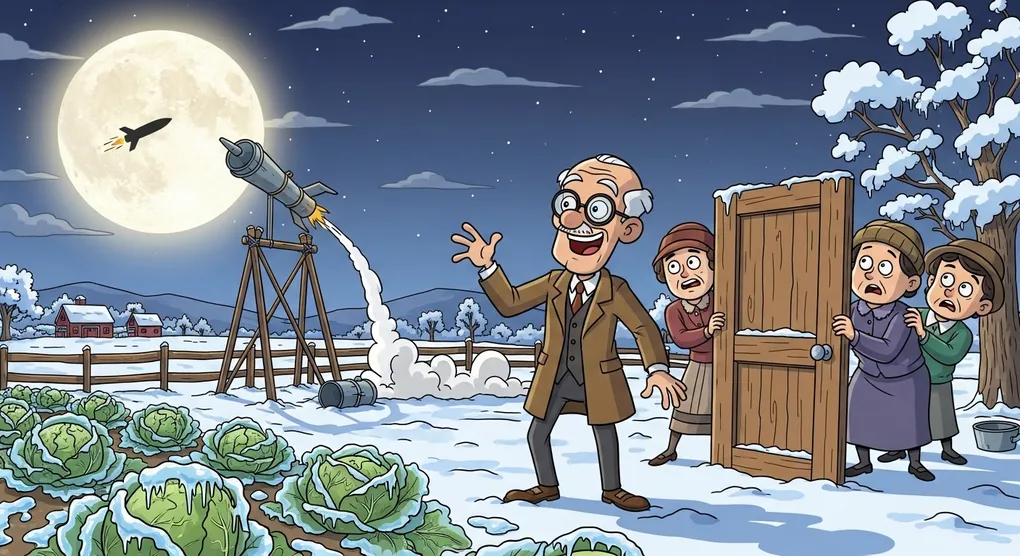
One hundred years ago this month, a physics professor named Robert Goddard dragged a homemade rocket to his Aunt Effie’s farm in Auburn. His wife Esther, his crew chief Henry Sachs, and a colleague from Clark University were the only people on Earth who knew what was about to happen. The rocket was about ten feet tall, built from thin metal pipes, and ran on liquid oxygen and gasoline. Sounds safe, right? It looked like something you’d find in a steampunk junkyard. There was no launch pad, no mission control, no countdown. Just a guy in a Massachusetts field with a dream and a questionable safety plan. Here’s how they lit it: Sachs held a blowtorch attached to the end of a long stick, reached up, and ignited the engine. Then he ran behind a propped-up wooden door. That was the blast shield. A door. Leaning against something. The engine burned for twenty seconds before it generated enough thrust to lift the rocket off its frame. Then it flew. For two and a half glorious seconds. It reached 41 feet. Traveled 184 feet. And crash-landed in a frozen cabbage field at roughly 60 miles per hour. How do they make Cole Slaw again? If you’re doing the math, that’s about as high as a telephone pole and about as far as you can throw a football if you’ve got a decent arm. The whole flight lasted less time than it takes to sneeze twice. Goddard didn’t call the press. He didn’t post about it. He kept the whole thing quiet for a decade.
The Gray Lady Gets It Wrong
He had good reason to stay quiet. Six years earlier, in 1920, Goddard had published a paper suggesting that rockets could theoretically reach the moon. The New York Times responded with an editorial that was somewhat… unkind. The Times editorial board suggested that Professor Goddard “does not know the relation of action to reaction, and of the need to have something better than a vacuum against which to react.” Translation: this dummy thinks rockets work in space, and everybody knows you can’t push against nothing. This was, of course, spectacularly wrong. Newton’s Third Law doesn’t require air. That’s literally the whole point. A rocket works by throwing mass out the back, and the reaction pushes it forward. It works in a vacuum, in the atmosphere, or in your bathtub. It doesn’t care. But the Times said it with such confidence that it stuck. Goddard, already a private person, became even more reclusive. He moved his experiments to the New Mexico desert, away from reporters and neighbors who kept calling the fire department. The correction came on July 17, 1969. The day after Apollo 11 launched for the moon. The Times published a brief note acknowledging that rockets do, in fact, work in space, and expressing regret for the error. Forty-nine years late. Three paragraphs long. Buried on page 43. Better late than never, I suppose. Though I’d argue “never” and “49 years” are basically the same thing when you’re the guy who was right all along and died in 1945 without seeing the correction.
What He Built While Nobody Was Watching
Here’s what makes Goddard’s story remarkable beyond the obvious. After that frozen cabbage field moment, he didn’t stop. He just stopped telling people about it. Over the next fifteen years, working mostly alone in Roswell, New Mexico (yes, that Roswell), Goddard built rockets that reached altitudes of nearly 9,000 feet. He developed gyroscopic stabilization. He invented the first practical fuel pump for liquid-propellant rockets. He was awarded 214 patents, 131 of them after his death. The German V-2 rocket program used many of his innovations. When asked about it after the war, Wernher von Braun reportedly said, “Don’t you know about your own Goddard? He was ahead of us all.” NASA’s Goddard Space Flight Center in Greenbelt, Maryland, carries his name. So does a crater on the far side of the moon, which feels like the universe has a sense of poetic justice.
One Hundred Years from Cabbage Field to the Moon
Tomorrow, April 1, 2026, the Space Launch System rocket will light its engines at Kennedy Space Center. No blowtorch on a stick this time. The SLS generates 8.8 million pounds of thrust, which is roughly 978,000 times more powerful than Goddard’s little pipe rocket. Artemis II will carry four astronauts around the moon and back over ten days, the first humans to travel beyond low Earth orbit since Apollo 17 in 1972. Victor Glover will become the first person of color to travel that far from Earth. Christina Koch will be the first woman. Jeremy Hansen will be the first non-American. Commander Reid Wiseman will lead them. One hundred years. From a frozen cabbage field in Massachusetts to a crewed flight around the moon. Goddard’s rocket weighed about ten pounds. The SLS weighs 5.7 million pounds. His flight lasted 2.5 seconds. Artemis II will last ten days. His rocket reached 41 feet. These astronauts will travel about 230,000 miles. The distance between those two moments is almost too big to comprehend. But here’s the thing that gets me: the physics is exactly the same. Newton’s Third Law. Action and reaction. The same principle the New York Times said wouldn’t work in a vacuum.
The Part That Matters
Goddard died of throat cancer in 1945, twenty years before anyone walked on the moon. He never saw the space age he built the foundation for. He never got to say “I told you so” to the New York Times. He just kept building rockets in the desert, collecting patents, and trusting the physics. Tomorrow, when Artemis II lights up the Florida sky, four astronauts will ride a column of fire toward the moon on principles that a quiet professor proved in a cabbage field one hundred years ago. I think he’d like that. Even if it didn’t make the local paper.